
A water heater replacement quote should identify the water heater type, fuel source, capacity or flow rating, first hour rating where relevant, EnergyGuide or efficiency information, venting or electrical work, permit and inspection responsibility, safety components, removal of the old unit, access constraints, warranty coverage, payment timing, and written change-order rules.
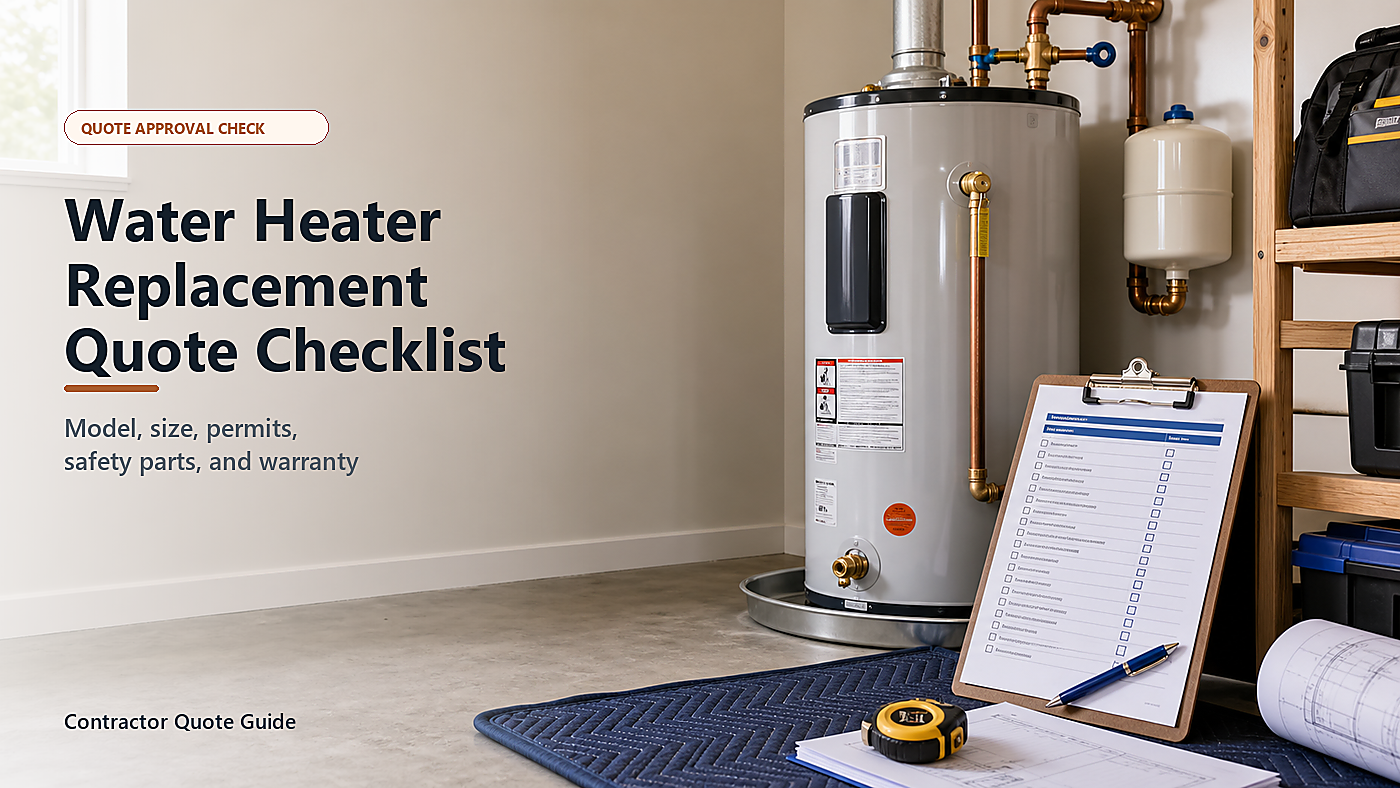
A water heater quote can look simple because the appliance itself is familiar. Remove old tank. Install new tank. Restore hot water. Collect payment. That is the version homeowners hear when the house is already inconvenient and everyone wants the job done quickly.
The real quote has more moving parts. Fuel type, venting, electrical capacity, drain pan, expansion tank, temperature and pressure relief valve, shutoff valves, code requirements, access, haul-away, warranty, and inspection can all affect the job. This guide does not invent a national replacement price. It shows what to inspect before approving the estimate.
Start With What Is Being Replaced
Before comparing contractor numbers, write down what is in the house now. A quote for a like-for-like storage tank is not the same as a quote for a heat pump water heater, tankless conversion, fuel switch, relocation, or larger-capacity replacement.
Ask the contractor to identify:
- Current water heater type and fuel source
- Tank capacity or tankless flow rating
- Age, visible leaks, rust, venting condition, and access limits
- Whether the new unit is like-for-like or a conversion
- Whether permits, inspection, or code updates are expected
If the quote only says “replace water heater” with one total price, it is not ready to approve.
1. Confirm Fuel Type Before Talking About Size
The Department of Energy says fuel type affects operating cost, size, and efficiency. That matters because the fuel source is not just a label on the box. Natural gas, propane, electricity, heat pump electric, solar, and indirect systems can involve different installation work.
A like-for-like replacement may still require updated fittings or code items. A conversion can require more: electrical work, breaker capacity, gas line work, combustion air, venting, condensate handling, or a different installation location.
Ask the quote to state the fuel type and whether the contractor is changing the home’s fuel setup. If another trade is needed, such as an electrician, the estimate should say whether that work is included, excluded, or separately priced.
2. Do Not Compare Tank Size Alone
A 50-gallon label does not tell the whole story. DOE sizing guidance points homeowners to first hour rating for storage and heat pump units with tanks. First hour rating is about how much hot water the unit can deliver in a heavy-use hour, not just how much the tank holds.
For tankless systems, the sizing question changes. The quote should discuss expected flow rate and temperature rise. A tankless unit that works well for one shower may not serve two showers, a washing machine, and a kitchen sink at the same time.
Ask for the sizing logic in writing:
- What household demand did the contractor assume?
- What capacity, first hour rating, or flow rate is quoted?
- Does the quote account for simultaneous hot-water use?
- Does the quote explain why the selected model fits the home?
Bigger is not automatically better. DOE notes that oversized storage units can cost more to buy and can increase standby energy losses. The right quote explains the match.
3. Ask For The Exact Model, Not A Generic Unit
Homeowners should not approve a quote that hides the actual equipment. The estimate should list manufacturer, model number, capacity, fuel type, efficiency rating, warranty term, and included accessories.
The FTC’s EnergyGuide guidance explains that the yellow label helps shoppers compare energy use with similar appliances. For water heaters that carry EnergyGuide information, ask the contractor to provide the label or a model page before installation day.
The model matters for warranty, efficiency, dimensions, venting, service parts, and whether the unit physically fits the space. A quote that says “40-gallon gas water heater” leaves too much room for substitution.
4. Venting, Combustion Air, And Exhaust Are Scope Items
Gas and oil-fired water heaters involve venting and combustion safety. Tankless gas units may need different vent materials or routing than an old atmospheric tank. High-efficiency units can involve condensate handling. Some locations may need code updates before inspection passes.
This is not an area for vague language. The quote should say whether existing venting will be reused, modified, replaced, inspected, or excluded. It should also name who is responsible if the old venting is not acceptable.
For electric and heat pump units, the quote should cover electrical requirements and installation location. DOE notes heat pump water heaters need appropriate temperature conditions and air space to operate efficiently. If the unit needs a different location, ducting, condensate drain, or electrical upgrade, that belongs in the quote.
5. Safety Parts Should Be Named
A replacement is not only the tank. A complete installation may include shutoff valves, dielectric unions or appropriate connectors, drain pan, discharge pipe, temperature and pressure relief valve, expansion tank where required, gas shutoff or sediment trap where applicable, earthquake straps where required, pipe insulation, and new supply lines.
Local requirements vary. The point is not that every part applies to every home. The point is that the quote should not hide basic safety and code components inside a vague “standard install” phrase.
Ask the contractor to mark each safety or code item as included, not needed, or extra. That makes it easier to compare two estimates that appear close in price.
6. Permit And Inspection Responsibility Should Be Clear
Water heater replacement can require local permits and inspection. DOE’s contractor-selection guidance tells homeowners to see whether the company will obtain a local permit if needed and understands local building codes.
The quote should answer four questions:
- Is a permit expected for this job?
- Who pulls the permit?
- Is the permit fee included in the quote?
- Who schedules and handles inspection follow-up?
If a contractor says no permit is needed, ask them to put that assumption in writing. Homeowners do not need a code lecture. They need to know who is responsible if the local authority requires paperwork.
7. Removal, Disposal, And Work Area Protection Belong In The Price
Removing an old water heater can be straightforward, or it can be awkward. Stairs, tight closets, finished basements, attic locations, crawlspaces, drain access, rusted connections, and leaking tanks can all change the work.
The quote should say whether draining, disconnecting, haul-away, disposal, floor protection, cleanup, and minor patching are included. It should also state what happens if the old unit is full of sediment, cannot drain normally, or leaks during removal.
That is not being picky. It is how homeowners avoid a surprise fee while the old tank is already halfway out of the house.
8. Temperature Settings And Anti-Scald Concerns Should Be Discussed
The Consumer Product Safety Commission warns about tap-water scald injuries and urges users to lower water heaters to 120 degrees Fahrenheit. Some homes may have special needs, appliances, or mixing valves, so homeowners should ask the contractor how the final temperature setting will be handled.
This is especially important in homes with children, elderly residents, or guests. The quote should not promise medical safety, but the contractor can explain the normal set point, thermostat access, anti-scald devices where relevant, and what the homeowner should verify after installation.
Ask for startup instructions, not just a finished invoice.
9. Warranties Need Two Columns
Water heater warranties can be confusing because equipment coverage and labor coverage are not the same thing. The manufacturer may cover certain parts for a stated period. The contractor may cover installation labor for a shorter period. Extended warranties may change the price.
Ask the quote to separate:
- Manufacturer tank or heat exchanger warranty
- Parts warranty
- Contractor labor warranty
- Registration requirements
- What voids the warranty
- Who handles a warranty claim
A long equipment warranty does not help much if the homeowner pays unexpected labor and diagnostic charges later.
10. Change Orders Should Be Decided Before The Tank Is Drained
Water heater jobs can uncover issues after work starts: corroded shutoffs, missing expansion control, undersized venting, failed drain valves, damaged floor, noncompliant discharge piping, electrical limits, or a closet that does not fit the selected unit.
The quote should explain how extras are approved. The best version is simple: the contractor documents the issue, gives a price or pricing method, gets homeowner approval, and then proceeds.
Without that rule, the homeowner may feel forced to accept a new charge because the house has no hot water.
Water Heater Quote Review Table
| Quote Line | What To Look For | Question To Ask |
|---|---|---|
| Equipment | Manufacturer, model, fuel, capacity, efficiency, warranty | Which exact model will be installed? |
| Sizing | First hour rating, tank size, flow rate, temperature rise | What household demand did you size this for? |
| Venting or electrical | Reuse, modification, replacement, excluded trade work | What happens if existing venting or wiring is not acceptable? |
| Safety and code parts | T&P valve, discharge pipe, pan, expansion tank, straps, shutoffs | Which items are included, not required, or extra? |
| Permit | Permit puller, fee, inspection, correction responsibility | Who handles the permit and inspection? |
| Removal | Draining, haul-away, disposal, floor protection, cleanup | Is old-unit removal fully included? |
| Warranty | Equipment, parts, labor, registration, claim process | Who do I call if it fails after installation? |
| Change orders | Approval rule, unit pricing, documentation, photos | What can change the price after work starts? |
Message To Send Before Approving
Please update the quote with the exact water heater model, fuel type, capacity or first hour rating, efficiency information, included safety/code parts, venting or electrical assumptions, permit responsibility, removal and disposal, warranty terms, and the written change-order process before I approve the work.
Related Contractor Scope Guides
- Comparing Electrical Panel Upgrade Bids: Scope, Exclusions, and Signing Checks
- Septic Riser and Lid Quotes: Safe Access Without Scope Gaps
- Private Well Treatment Quotes: Start With the Test Report
- Interactive Contractor Quote & Scope Comparison Calculator
FAQ
What should a water heater replacement quote include?
It should include the exact model, fuel type, capacity or flow rating, efficiency information, installation scope, safety components, venting or electrical work, permits, removal, disposal, warranty, payment terms, and change-order rules.
Should homeowners choose the same size water heater again?
Not automatically. The quote should explain sizing based on household demand, first hour rating for storage-style units, or flow rate and temperature rise for tankless units. A like-for-like size may be fine, but it should still be justified.
Does a water heater replacement need a permit?
It depends on local rules and the scope of work. The quote should say whether a permit is expected, who pulls it, whether the fee is included, and who handles inspection follow-up.
What can make a water heater quote increase after work starts?
Common triggers include bad shutoff valves, venting problems, electrical or gas changes, missing required safety parts, difficult access, damaged flooring, failed draining, permit corrections, or a switch to a different water heater type.
Sources Checked
- Department of Energy: Selecting a New Water Heater
- Department of Energy: Sizing a New Water Heater
- Department of Energy: Storage Water Heaters
- Department of Energy: Tankless or Demand-Type Water Heaters
- Department of Energy: Heat Pump Water Heaters
- FTC: How To Use the EnergyGuide Label To Shop for Home Appliances
- CPSC: Avoiding Tap Water Scalds
The Approval Rule
Approve the water heater quote that makes the installation scope boringly clear. The best estimate is not the one with the fewest words. It is the one that says what unit is going in, what supporting work is included, who handles permits and inspection, how safety parts are treated, what happens if hidden issues appear, and who stands behind the work after hot water is restored.