
Short answer: a garage door replacement quote should identify the exact opening size, door type, material, insulation, window and finish choices, wind-load or impact requirements where they apply, tracks, rollers, hinges, springs, cables, opener work, photo-eye safety sensors, removal, disposal, trim, weather seals, permit or HOA responsibility, warranty terms, payment schedule, and written change-order rules.
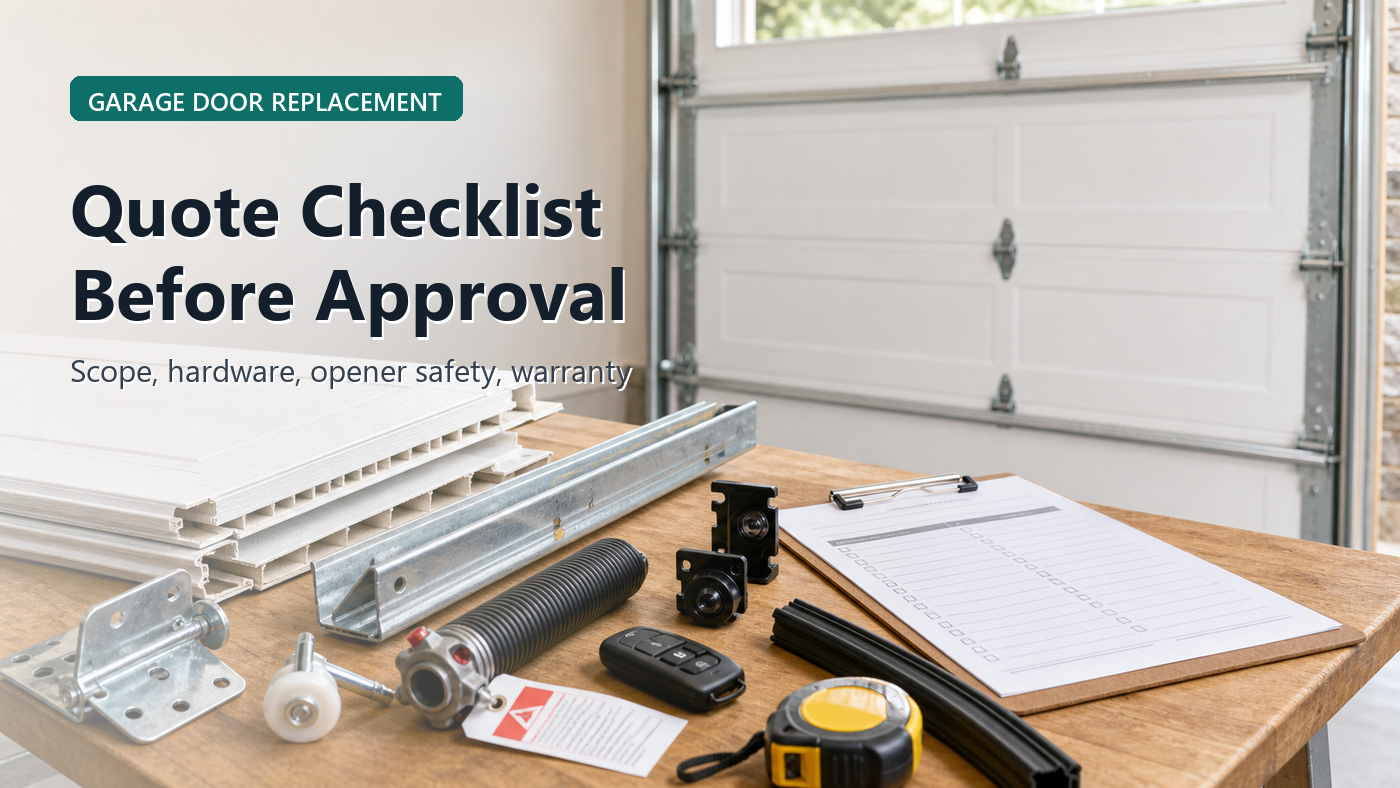
A garage door replacement can look simple from the driveway. The old door is dented, noisy, cracked, heavy, or ugly. A contractor measures the opening, names a door, and gives a number.
That number is not enough. The door is a moving wall. It has springs under tension, tracks, rollers, hinges, bottom brackets, cables, an opener, sensors, seals, trim, and sometimes local wind-rating rules. If the quote does not say what is included, the homeowner may approve a door and then discover that the opener, spring system, disposal, exterior trim, weather seal, or high-wind documentation was a separate conversation.
This guide does not pretend to know the right price for every garage door. It gives homeowners a way to read the quote before approval, compare bids on the same scope, and ask better questions before the existing door is removed.
Start With The Opening, Not The Door Style
Most garage door discussions start with style: carriage look, flush panels, raised panels, windows, color, wood-look finish, or modern glass. Style matters, but the first scope question is boring and more important: what opening is being replaced?
The quote should state the rough size or finished door size, whether it is a single-car or double-car opening, whether the door is sectional, whether the framing is square enough for normal installation, and whether any trim, jamb, stop molding, or weather seal work is included.
If two quotes use different assumptions about the opening, they are not comparable. One may be pricing a standard-size door with minimal trim work. Another may be accounting for uneven framing, a custom size, extra sealing, or replacement of damaged exterior boards.
1. Door Material And Panel Construction Should Be Named
A garage door quote should not say only “new garage door.” Ask for the material and panel construction. Steel, aluminum, fiberglass, composite, wood, and wood-look doors can all carry different maintenance, dent resistance, weight, insulation, finish, and warranty implications.
The quote should identify:
- Door material and product line
- Single-layer, double-layer, or insulated sandwich construction
- Panel style and color
- Window layout and glass type, if included
- Decorative hardware, if included
- Finish or paint assumptions
This keeps the homeowner from comparing a basic non-insulated steel door against a heavier insulated door with windows and upgraded hardware as if they were the same product.
2. Insulation Needs More Than A Marketing Label
Insulation matters most when the garage is attached, has living space above or beside it, contains plumbing, serves as a workshop, or faces extreme weather. It matters less when the garage is detached and used only for storage.
The quote should state the insulation type or product level, the published R-value if the manufacturer provides one, whether the door has thermal breaks, and whether new perimeter weather seals and bottom seal are included. R-value alone does not tell the full story if the door is poorly sealed around the edges.
Ask the contractor to separate the decision into two parts: the insulated door itself and the sealing work around the opening. A more expensive insulated door with weak perimeter sealing may disappoint. A basic door with good seals may be adequate for a detached garage.
3. Wind-Rated Doors Are A Scope Item, Not An Upgrade Word
In hurricane-prone, coastal, and other high-wind areas, the garage door can be part of the home’s storm-resistance plan. The Building America Solution Center explains that garage doors should be pressure-rated for the site’s design wind speed and exposure category in high-wind regions, and that failed garage doors can allow wind pressure to damage the larger building envelope.
The quote should say whether the home is being priced for a standard door or a pressure-rated door. If wind requirements apply, ask for the product approval, design pressure information, impact or glazing protection details, and the documentation the contractor will provide after installation.
Do not rely on a casual phrase like “hurricane door” or “wind code door.” Ask what rating or approval is being quoted and whether the included hardware, tracks, struts, fasteners, and installation method match that rating.
4. Tracks, Rollers, Hinges, Cables, And Springs Need Their Own Line
The visible door panels are only part of the replacement. The operating system matters. Tracks, rollers, hinges, cables, bottom brackets, spring assemblies, bearing plates, drums, and struts all affect safety and daily operation.
Ask whether the quote includes new tracks or reuses the existing tracks. Ask whether rollers, hinges, cables, and bottom fixtures are included. Ask whether the spring system is replaced, balanced for the new door weight, and covered by warranty.
This is not a do-it-yourself area. DASMA warns that garage door springs and related parts are dangerous, and that cables and spring systems should be handled by trained technicians. A homeowner does not need to service the spring system personally. The homeowner does need the quote to say what the installer is doing with it.
5. The Opener Should Be Treated Separately From The Door
A replacement door does not always require a new opener. Sometimes the existing opener is compatible and in good condition. Sometimes a heavier door, damaged rail, old safety equipment, missing features, or poor operation makes opener replacement sensible.
The quote should state whether the opener is:
- Reused with the new door
- Adjusted and tested only
- Replaced with a named model
- Excluded entirely
If a new opener is included, the quote should name the drive type, horsepower or lifting capacity language used by the manufacturer, wall control, keypad, remotes, battery backup if applicable, smart-home features if requested, and warranty terms.
If the old opener is reused, ask whether the installer will test travel limits, force settings, manual release, photo eyes, and reversal behavior after the new door is installed.
6. Safety Sensors Are Not A Small Detail
The Consumer Product Safety Commission says automatic residential garage door operators must comply with a federal safety standard. CPSC also describes entrapment-protection requirements for openers manufactured after January 1, 1993, including external entrapment protection such as an electric eye or similar device, and it urges owners to test the reversing feature monthly.
That means the quote should not ignore safety sensors. Ask whether photo-eye sensors are present, aligned, replaced, reused, or newly installed. Ask whether the wall button location, warning labels, manual release, travel limits, and opener reversal test are part of the final walkthrough.
If the contractor says the existing opener or sensors are too old, damaged, or unsafe to reuse, ask for the reason in writing. That keeps the discussion about observed conditions, not pressure to buy an unplanned upgrade.
7. Removal, Disposal, And Jobsite Protection Should Be Written Down
Garage door replacement creates bulky waste: old panels, tracks, springs, brackets, opener parts, packaging, and sometimes old trim. A low quote can look better if it quietly excludes haul-away or disposal fees.
The quote should say who removes the old door, whether haul-away is included, whether hazardous or damaged parts create extra fees, and how the garage will be protected during the work. If stored items, vehicles, ceiling racks, or wall shelves limit access, clarify who moves them and how much clear space the installer needs.
Do this before installation day. A garage full of boxes can slow the work or create damage disputes that neither side wants.
8. Trim, Weather Seals, And Exterior Finish Can Change The Result
The finished look is not only the door panel. The perimeter trim, stop molding, bottom seal, weatherstrip, threshold condition, exterior caulk, and paint touch-ups can make the new door look complete or unfinished.
The quote should say whether it includes new vinyl stop, perimeter weather seal, bottom seal, threshold work, jamb repair, exterior trim replacement, caulking, painting, or color-matched finish pieces. If the installer does not do paint or carpentry, that exclusion should be visible before approval.
Ask for photos of any rotten wood, cracked framing, or uneven concrete that could trigger extra work. The best time to discuss those items is before the old door is removed and the opening is exposed.
9. Permits, HOA Rules, And Product Paperwork May Matter
Permit rules vary by city, county, state, and project scope. HOA communities may also restrict color, window layout, panel style, or exterior appearance. High-wind areas may require product approvals or inspection documentation.
The FTC’s home improvement guidance tells consumers to get multiple estimates, read contracts carefully, make sure the contract includes scope and cost promises, and avoid automatically choosing the lowest bidder. For a garage door job, that means the quote should say who handles permit checks, HOA paperwork if needed, and product documentation after installation.
Ask these questions before approving the quote:
- Does this project require a permit in my location?
- Who is responsible for permit fees and inspection scheduling?
- Do HOA rules affect the door style or color?
- Will I receive manufacturer paperwork, wind-rating documentation, or warranty registration details?
If the contractor says no permit or approval is needed, ask them to put that assumption in the estimate.
10. Warranty Terms Should Be Split Apart
“Lifetime warranty” can sound better than it is. Garage door warranties may separate the door sections, paint or finish, hardware, springs, opener, accessories, labor, and service calls. Some terms apply only to the original purchaser. Some exclude salt air, impact damage, improper maintenance, or owner-supplied parts.
The quote should break out:
- Door section warranty
- Paint or finish warranty
- Spring warranty or cycle rating
- Hardware warranty
- Opener warranty, if included
- Installer labor warranty
- Service-call fees after installation
A short labor warranty on a complex installation may matter more than a long product warranty that excludes the problem most likely to happen.
11. Change Orders Should Be Decided Before The Old Door Comes Down
Garage door projects can reveal surprises: rotten jambs, cracked header trim, uneven concrete, damaged framing, blocked track clearance, poor opener support, missing electrical outlet, incompatible old opener, hidden water damage, or wind-code documentation that was not considered.
The quote should explain how changes are approved. A good rule is simple: the installer documents the issue, explains why it affects the work, gives a price or pricing method, gets homeowner approval, and then proceeds.
Without that rule, the homeowner may feel forced to approve extra charges because the garage opening is exposed and the project is half done.
Garage Door Replacement Quote Review Table
| Quote Area | What To Confirm | Question To Ask |
|---|---|---|
| Opening | Door size, single or double opening, framing condition, trim assumptions | What exact opening and door size are you pricing? |
| Door product | Material, panel style, color, insulation, windows, decorative hardware | Which door model and construction level are included? |
| Wind rating | Pressure rating, impact requirements, product approval, required hardware | Does my location require a pressure-rated or impact-rated door? |
| Hardware | Tracks, rollers, hinges, cables, springs, bottom brackets, struts | What hardware is replaced and what is reused? |
| Opener | Reuse, adjustment, replacement, safety sensors, remotes, keypad | Is the opener included, reused, or excluded? |
| Finish work | Stop molding, weather seals, jamb repair, caulk, paint exclusions | What will the finished opening look like? |
| Removal | Old door removal, disposal, packaging, jobsite cleanup | Is haul-away included in the quoted price? |
| Warranty | Door, finish, springs, hardware, opener, labor, service calls | Which warranty covers which part of the job? |
| Changes | Rot, framing damage, clearance problems, opener incompatibility, permit issues | How are change orders priced and approved? |
Message To Send Before Approval
Please update the garage door replacement quote with the exact door size, manufacturer or product line, material, insulation level, window and finish choices, wind-rating or product-approval requirements if applicable, tracks, rollers, hinges, cables, springs, opener and safety-sensor scope, trim and weather-seal work, removal and disposal, permit or HOA responsibility, warranty details, and the written change-order process before I approve the job.
FAQ
What should a garage door replacement quote include?
It should include the exact door size, product line, material, insulation, windows, finish, wind-rating requirements where applicable, operating hardware, opener and sensor work, trim and seals, removal, disposal, warranty, payment terms, and change-order rules.
Should homeowners replace tracks and springs with the door?
Not every project has the same requirement, but the quote should say what happens to tracks, rollers, cables, hinges, springs, and brackets. The new door must be properly balanced and compatible with the operating hardware.
Does a garage door opener need safety sensors?
Automatic residential garage door openers are subject to federal safety requirements, and modern systems use entrapment protection such as photo-eye sensors or similar devices. The quote should say whether sensors are replaced, reused, aligned, and tested after installation.
What can make a garage door replacement quote increase?
Common triggers include custom sizing, damaged framing, rotten trim, uneven concrete, opener incompatibility, high-wind product requirements, window or finish upgrades, missing electrical work, disposal exclusions, permit issues, and hardware that cannot be reused safely.
Sources Checked
- CPSC: Automatic Residential Garage Door Operators
- CPSC: Final Rules For Automatic Garage Door Openers
- Building America Solution Center: Garage Doors Are Pressure Rated
- FTC Consumer Advice: How To Avoid A Home Improvement Scam
- DASMA: Garage Door Systems Safety Tips
The Approval Rule
Approve the garage door quote only when it reads like a complete door system, not a one-line panel price. The quote should explain the opening, door product, hardware, opener safety items, storm requirements, finish work, disposal, warranty, and change-order process clearly enough that the homeowner can compare competing bids without guessing what each installer left out.