
An attic insulation quote should name the existing insulation condition, target R-value, insulation type, air-sealing scope, rafter baffles, ventilation protection, attic hatch work, recessed light and flue clearances, duct protection, moisture or pest exclusions, cleanup, documentation, warranty, and change-order rules before the homeowner approves the job.
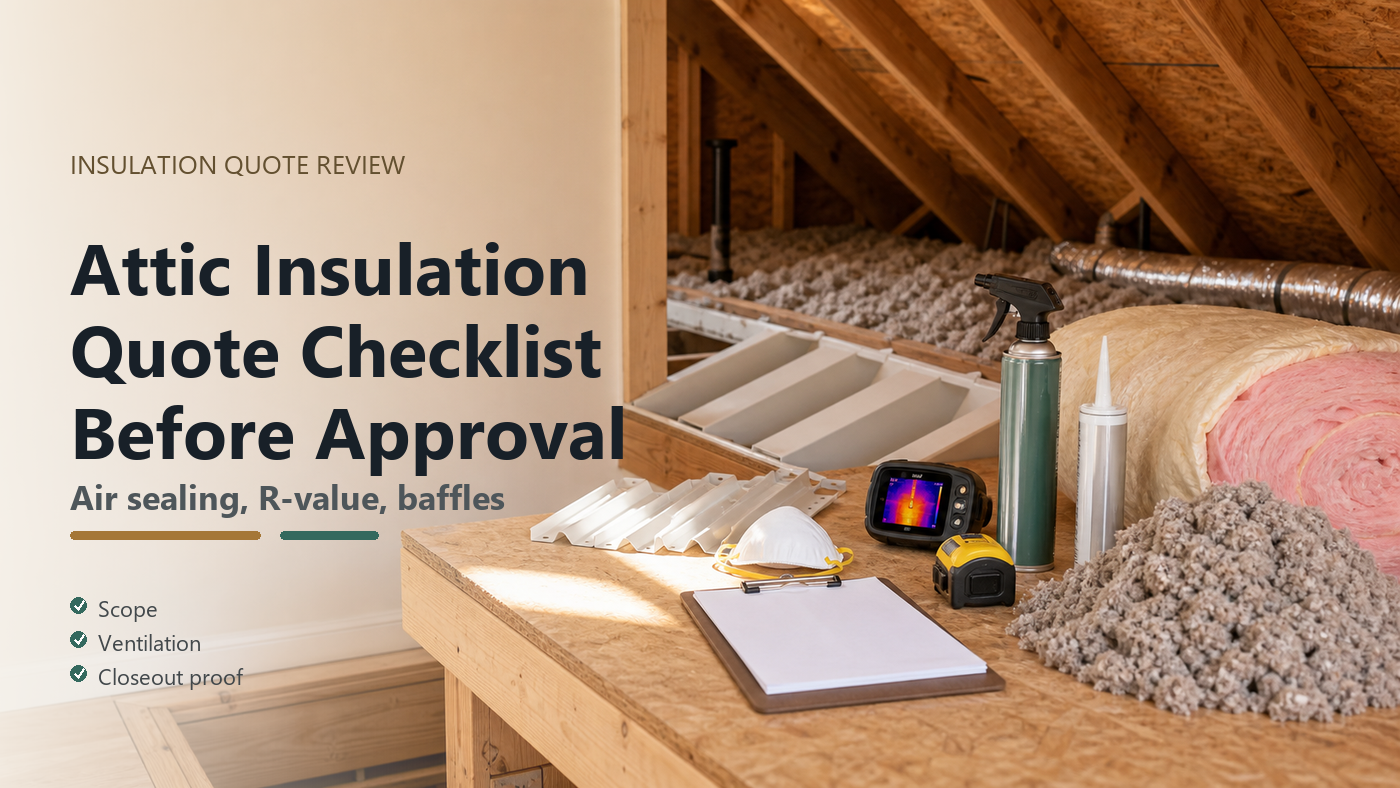
An attic insulation quote can be misleadingly short. It may say “blow in insulation to R-49” or “add attic insulation,” then give one number. That number is not enough. The real value of the job depends on what happens before the insulation goes in, what gets protected, what gets left alone, and what documentation the homeowner receives at the end.
This guide does not guess a local insulation price. It shows how to compare scope. Two attic quotes can use the same R-value and still be very different projects if one includes air sealing, baffles, hatch insulation, light covers, and cleanup while the other only adds material over the existing attic floor.
Start With The Current Attic, Not The Bag Count
Before asking how many bags or inches the contractor will add, ask what is already in the attic. A good quote should describe the current insulation type, approximate depth, obvious gaps, compressed areas, signs of moisture, pest activity, old debris, blocked vents, exposed ducts, and attic access constraints.
The Department of Energy explains that insulation performance depends on how and where it is installed, and compressed insulation does not provide its full rated R-value. That matters in attics where old insulation has been disturbed by storage, wiring, ducts, repairs, or foot traffic.
If the contractor has not inspected the attic, the quote should say it is preliminary. If the contractor has inspected the attic, ask them to put the conditions in writing or provide photos.
1. Target R-Value Should Match Climate And Existing Depth
R-value measures resistance to heat flow. ENERGY STAR describes higher R-value as better thermal performance and publishes recommended insulation levels by climate zone and existing insulation condition.
The quote should state the target R-value, the current approximate R-value or depth, and the material depth needed to reach the target. “Add insulation” is too vague. “Add blown cellulose to bring attic floor from about R-19 to R-49” is much clearer.
Ask these questions:
- What R-value is the contractor targeting?
- What climate zone or local standard is being used?
- How much existing insulation is present?
- What installed depth is expected after settling?
- Will depth markers be installed or photographed?
Do not treat R-value as the whole job. It is one important line item inside a bigger attic scope.
2. Air Sealing Should Be Listed Before New Insulation
ENERGY STAR says contractors should seal air leaks in the attic floor before adding insulation because it is easier to seal first and helps the insulation perform. This is one of the biggest quote differences.
Air sealing can include gaps around plumbing penetrations, wiring holes, top plates, open chases, dropped soffits, attic hatches, bath fan penetrations, flues, and recessed light housings. Some of these require specific materials, such as fire-rated sealant or metal flashing near hot surfaces.
If a quote includes air sealing, it should say where, how, and with what materials. If it does not include air sealing, ask whether the contractor is only adding insulation. A lower quote may simply skip work that matters.
3. Baffles And Ventilation Protection Need Their Own Line
Attic insulation should not block soffit ventilation. ENERGY STAR says estimates should include insulation baffles or rafter vents so soffit vents remain clear and attic airflow is preserved.
The quote should identify whether baffles are included, how many are expected, where they will be installed, and whether blocking or dams will prevent loose-fill insulation from spilling into soffits. If the attic has no soffit vents, blocked soffits, gable vents, ridge vents, or powered ventilation, ask the contractor to explain how that affects the plan.
A quote that adds insulation all the way to the eaves without discussing baffles can create a future ventilation or moisture problem.
4. Existing Insulation Removal Is Not Always Required
Removal can be expensive and messy, so it should not be assumed either way. ENERGY STAR notes that unless old insulation is wet, moldy, smelly, or contains animal waste, contractors can often add new insulation on top.
The quote should state whether existing insulation will be left, redistributed, vacuumed, or removed. If removal is included, ask what triggers it, how debris is bagged, whether the attic is cleaned before new insulation, and whether disposal is included.
If removal is excluded, ask what happens if the crew finds wet insulation, animal waste, heavy dust, or hidden damage after work begins.
5. Recessed Lights, Flues, And Heat Sources Need Safety Details
Attics often contain recessed lights, bath fans, flues, chimneys, wiring, junction boxes, and sometimes equipment. ENERGY STAR warns not to lay insulation over recessed light fixtures unless they are rated for insulation contact, and it recommends sealing around flues with metal flashing and high-temperature caulk where appropriate.
The quote should explain how the crew will handle can lights, non-IC fixtures, chimneys, furnace flues, water heater flues, and bath fan exhaust paths. If special covers are needed, they should be included or listed as an allowance.
This is not a place for a verbal “we take care of it.” Ask for the safety treatment in writing.
6. Attic Hatch, Pull-Down Stairs, And Access Are Part Of The Job
An uninsulated attic hatch can be a weak spot after the rest of the attic is improved. ENERGY STAR recommends weatherstripping and insulating attic hatches or doors.
The quote should say whether hatch insulation, weatherstripping, an attic stair cover, access dam, or protective barrier is included. It should also say whether the crew will protect floors, walls, closets, stairs, and furniture while moving hoses and materials through the house.
Access affects labor. A tight scuttle hole, steep pull-down stairs, finished closet entry, or long hose run can change how the job is performed.
7. Ducts, Bath Fans, And Attic Equipment Need Boundaries
If ducts run through the attic, the quote should say whether they are being protected, sealed, buried, insulated, or simply avoided. ENERGY STAR notes that ducts can be buried in insulation only if they are well sealed first, and contractors should avoid stepping on or damaging them.
Bath fans should exhaust outside, not into the attic. If the contractor sees a fan dumping moist air into the attic, the quote should either include correction, exclude it clearly, or recommend a separate repair before insulation is added.
The same applies to HVAC equipment, wiring, alarms, recessed fixtures, and storage platforms. The more stuff in the attic, the more important the scope boundary becomes.
8. Moisture, Roof Leaks, Pests, And Mold Are Not Just Insulation Issues
Wet insulation, roof leaks, pest activity, and mold-like staining can change the project. ENERGY STAR recommends asking contractors to notify homeowners if they notice wet insulation, roof leaks, or signs of pests.
The quote should state what is excluded and what happens if the crew finds trouble. Will work pause? Will photos be provided? Will the contractor remove contaminated insulation? Is a roofer, pest professional, mold professional, or HVAC contractor needed first?
Do not let an insulation quote quietly cover up a moisture problem. Insulation can improve comfort, but it is not a roof repair, pest cleanup, or mold remediation plan.
9. Material Type Should Be More Specific Than “Insulation”
Common attic materials include blown fiberglass, blown cellulose, fiberglass batts, mineral wool in limited areas, spray foam in specific assemblies, and specialty air-sealing materials. Each has different installation details, depth expectations, and cleanup concerns.
The quote should name the material, manufacturer or product line if available, target depth, R-value, coverage area, and whether the material is faced or unfaced. ENERGY STAR notes that if rolls are used on attic floors, they should generally be unfaced so moisture is not trapped.
If the contractor proposes radiant barrier or reflective material, ask how it fits the actual problem. DOE notes that radiant barriers do not have inherent R-value in the same way traditional insulation materials do.
10. Completion Documentation Should Be Required
At the end of the job, ENERGY STAR says the contractor is required to provide documentation showing how much insulation was added and the new attic R-value. Ask for that documentation before approving the quote.
A good closeout packet can include before photos, after photos, depth marker photos, product information, warranty terms, air-sealing notes, baffle locations, cleanup confirmation, and any exceptions discovered during the job.
Final payment should be tied to a walkthrough and documentation, not just the fact that insulation has been blown into the attic.
Attic Insulation Quote Scorecard
| Quote Area | What To Confirm | Why It Changes The Scope |
|---|---|---|
| Existing condition | Current depth, material, gaps, moisture, pests, access | Hidden problems can change removal, cleanup, or repair needs |
| Target R-value | Climate zone, current level, final R-value, installed depth | Bag count alone does not prove final performance |
| Air sealing | Penetrations, top plates, chases, hatch, flues, fixtures | Insulation performs better when air leaks are handled first |
| Baffles | Rafter vents, soffit protection, dams, ventilation path | Blocked vents can create airflow and moisture problems |
| Removal | Leave, redistribute, vacuum, disposal, contamination rules | Removal can be a major cost and should be justified |
| Safety clearances | Can lights, flues, chimneys, bath fans, wiring, ducts | Unsafe coverage can create fire, moisture, or performance issues |
| Closeout | Photos, R-value documentation, cleanup, warranty, payment terms | Final proof matters after the attic is covered |
Message To Send Before Approving
Before I approve the attic insulation quote, please confirm the current attic condition, target R-value, insulation material and installed depth, air-sealing locations, baffle/rafter vent plan, treatment for recessed lights and flues, whether existing insulation will be removed or left in place, cleanup expectations, and the documentation I will receive after the job.
Related Home Repair & Remodel Guides
- Exterior Continuous Insulation Quote: WRB, Windows, Fasteners, And Drying
- Residential Elevator Safety Retrofit Quote: Door Gap, Controls, And Inspection
- Impact Window Replacement Quote: Labels, Pressure, And Flashing
- Interactive Contractor Quote & Scope Comparison Calculator
FAQ
What should an attic insulation quote include?
It should include current attic condition, target R-value, insulation type and depth, air-sealing scope, baffles, ventilation protection, hatch treatment, safety clearances, removal rules, cleanup, warranty, documentation, payment terms, and change-order rules.
Should air sealing be done before attic insulation?
Yes, in most attic projects air sealing should be handled before new insulation is added because leaks are easier to reach first and sealed leaks help the insulation perform better.
Does old attic insulation always need to be removed?
No. Existing insulation often can remain if it is dry and not contaminated. Removal should be discussed when insulation is wet, moldy, smelly, pest-contaminated, heavily damaged, or blocking needed work.
Why do attic insulation quotes mention baffles?
Baffles, also called rafter vents, help keep soffit vents clear so insulation can cover the attic floor without blocking ventilation. They are a key scope item when adding insulation near the eaves.
Sources Checked
- Department of Energy: Insulation
- ENERGY STAR: Well-Insulated and Sealed Attic
- ENERGY STAR: Recommended Home Insulation R-Values
- ENERGY STAR: About Attic Ventilation
- FTC: How To Avoid a Home Improvement Scam
- FTC: Hiring a Contractor
The Bottom Line
A strong attic insulation quote is not just an R-value and a price. It explains the starting condition, the air-sealing work, the ventilation protection, the material and depth, the safety clearances, the cleanup, and the final documentation. If those details are missing, the homeowner may be buying insulation without buying the performance they expected.