
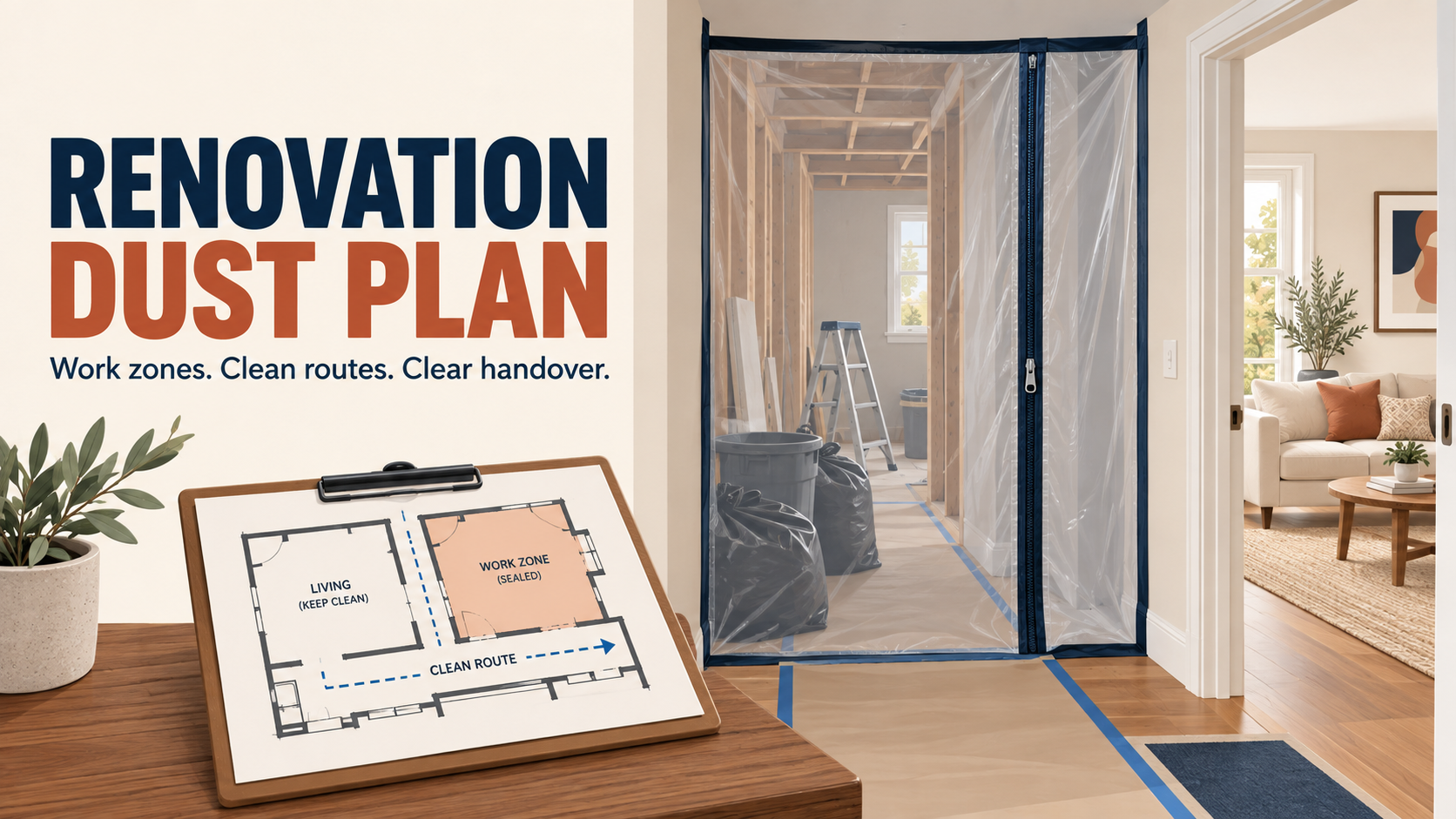
Before an occupied-home remodel starts, ask for a written plan covering work-area separation, air handling, debris routes, daily cleanup, and permission to reopen rooms. “We put down plastic” does not explain how the contractor will manage dust throughout demolition and finishing. The plan should describe the actual home and the people who will remain there.
This guide helps an owner review a contractor’s scope. It is not an instruction sheet for containing hazardous materials. Suspected lead, asbestos, or other material-specific hazards require appropriate assessment and procedures before disturbance. A general dust-control allowance is not a substitute for that work.
Draw the occupied home as well as the work area
Mark the rooms under construction, rooms still in use, entrances, stairs, and shared circulation routes. Include where workers and materials will enter and where debris will leave. A contractor can then explain how the work boundary changes when a hallway or doorway is part of the project.
Tell the contractor about planned occupancy before the bid is finalized. A household working from home creates different access questions from an empty property. Discuss children, pets, and any occupant concerns with the relevant professionals so the work plan can address access and suitability without promising that remaining in the house is always appropriate.
Ask who can change the boundary
One person should own decisions about moving a barrier, reopening a passage, or expanding the work zone. If several trades operate independently, ask how they will learn the same rules. A good drawing is only useful if the people carrying material through the doorway know when and how it applies.
Use a room-release list
Give each room a simple status: occupied, work in progress, cleaning or verification pending, or released for use. Ask the contractor which conditions must be met before the status changes. This is a communication tool, not a replacement for any material-specific clearance or verification requirement.
Connect the air plan to the existing house
EPA’s remodeling guidance discusses ventilation and containment to limit the spread of pollutants. Ask the contractor how the proposed approach interacts with the home’s heating, cooling, and ventilation system. The answer should identify who assesses air movement, equipment placement, and any necessary operating changes.
Ask where air will be drawn from and discharged, and whether the proposed location affects occupied areas, neighbors, or equipment. Do not specify a fan arrangement yourself from a generic diagram. The contractor should assess the actual home, including relevant combustion-appliance concerns, before choosing the method.
| Plan element | Owner’s question | Useful written detail |
|---|---|---|
| Separation | What prevents routine traffic through the work zone? | Boundary drawing and access points |
| Air handling | Who assesses the existing systems? | Responsible trade and operating plan |
| Debris | Where does waste travel and wait? | Removal route and storage location |
| Daily care | Who checks the condition after each shift? | Named supervisor and checklist |
| Room release | What evidence is needed before reoccupation? | Cleaning and verification criteria |
Resolve material questions before demolition
EPA recommends addressing indoor environmental concerns when remodeling rather than discovering them after materials have been disturbed. Ask what information about the existing finishes, insulation, flooring, and other affected materials the contractor needs before work begins. The quote should identify surveys or tests that remain outside the base scope.
For suspected asbestos-containing material, EPA advises assessment by appropriately trained professionals and cautions against disturbing it casually. Do not collect your own samples to speed up bidding. Ask who performs the assessment, how a finding changes the schedule, and what work stops until the issue is resolved.
Our asbestos removal quote guide covers that separate specialist scope. The lead paint project checklist provides another distinct set of questions. Neither should be collapsed into an ordinary housekeeping charge.
Make daily cleanup observable
Ask which surfaces, paths, and tools are included in daily cleanup and how debris will be packaged and removed. Establish where you can report dust outside the agreed boundary without entering the work zone. The contractor should explain who investigates the report and what changes before dusty work resumes.
For example, imagine a hypothetical bathroom remodel where the only path to the exterior crosses an occupied kitchen. A bid that describes the bathroom barrier but ignores that route leaves a major operational question open. Ask the contractor to show the route, protection, timing, and cleanup responsibility on the plan before comparing the price with another offer.
The number of workers can change from day to day. Agree that the supervisor reviews the plan with incoming subcontractors and checks the work area after they leave. This avoids a handoff where each trade assumes another person restores the boundary or removes the day’s debris.
Decide what happens when the plan fails
- Name the person an occupant contacts for a breached barrier or dust outside the work area.
- Describe which work pauses while the condition is assessed.
- Record additional cleaning or specialist review when needed.
- Confirm who communicates revised access arrangements.
- Agree on the evidence required before reopening affected rooms.
- Keep unresolved items visible in the project closeout record.
A useful proposal includes both prevention and response. Ask whether additional work caused by an unexpected material finding is priced separately and how that decision will be documented. Keep the explanation specific enough that you can tell a routine cleanup task from a new specialist project.
At handover, review the released-room list, cleaning records, and any required inspection or verification documents. The absence of visible dust does not establish that every material-specific requirement has been satisfied. Request the evidence appropriate to the actual work, then keep it with the final scope and contractor contacts.
Frequently asked questions
Is a plastic doorway barrier a complete plan?
No. Access, air handling, waste movement, cleaning, and room-release decisions also need an owner.
Can an air cleaner replace containment?
Do not assume so. Ask the contractor to explain how equipment fits the assessed work method and the home’s systems.
Should I stay in the house during demolition?
That depends on the work, materials, and occupants. Discuss suitability with the contractor and relevant professionals before agreeing to occupancy.
Who should investigate suspected asbestos?
An appropriately trained professional. Avoid disturbing or sampling suspect material yourself.
What makes the quote reviewable?
A drawing, named responsibilities, daily procedures, and clear conditions for reopening rooms, with specialist work identified separately.
Primary references
- EPA: indoor air quality best practices during remodeling
- EPA: addressing indoor environmental concerns during remodeling
- EPA: protecting your family from asbestos exposure
Sources checked September 14, 2026. Site conditions and applicable material-specific rules determine the final work plan.