
Short answer: Compare a whole-house surge protection installation quote by requiring an assessment of the service and every affected panel, locally applicable code and permit requirements, a listed device with documented voltage, configuration and surge-current ratings, a compatible breaker or connection method, short and orderly conductor routing, verified grounding and bonding, safe shutdown and restoration, inspection, indicator and replacement instructions, and explicit equipment and connected-product warranty terms. Panel-mounted protection complements rather than replaces proper wiring, grounding, point-of-use protection, and lightning-risk planning.
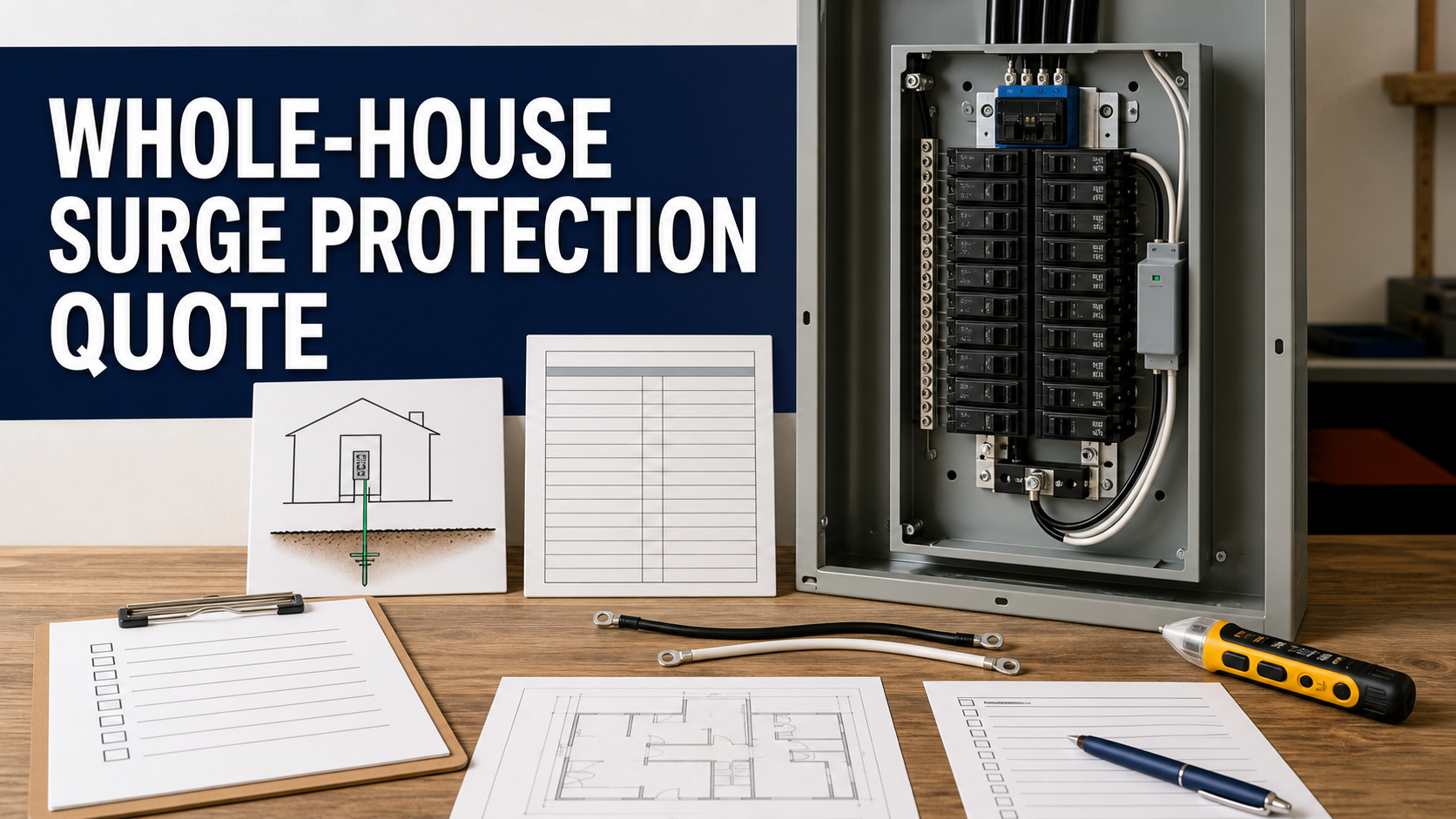
Two bids that both say whole-house surge protector may describe different installation locations, electrical configurations, conductor lengths, breaker needs, grounding corrections, indicator visibility, and downstream coverage. The panel nameplate, service arrangement, local rules, and existing defects determine the actual scope.
Do not compare proposals by a single maximum-amps number. Ratings, voltage configuration, installation location, connection path, conductor routing, modes of protection, status indication, replacement condition, and warranty eligibility must be read together.
Assess The Service And Distribution System
Identify service voltage and configuration, service disconnect, meter arrangement, main and subpanels, separately derived systems, generators, transfer equipment, solar, batteries, EV equipment, detached buildings, sensitive loads, panel make and condition, breaker space, working clearance, and prior surge or lightning damage. Photograph nameplates without exposing private account data.
The electrician should flag heat damage, corrosion, loose connections, obsolete or incompatible equipment, double taps, missing covers, grounding or bonding defects, and capacity concerns as included corrections or priced alternates rather than silently attaching a device.
Confirm Code, Permit, And Product Listing
State the adopted electrical code and local amendments, permit, inspection, authority having jurisdiction, utility coordination, and whether the project triggers other service or panel corrections. CPSC describes the NEC as a widely adopted model code intended to protect people and property from electrical hazards; the local adoption controls the job.
Require the surge protective device to be listed and marked for the proposed application, voltage, phase, system, enclosure, and location. Keep product selection and installation instructions in the closeout file.
Compare Ratings In Context
Record device type, nominal system voltage, maximum continuous operating voltage, voltage protection rating, nominal discharge current, surge-current capacity, protection modes, enclosure rating, frequency, short-circuit current rating or required coordination, and replaceable-module status where applicable. Ask the electrician to explain which ratings affect this installation.
A larger advertised surge-current figure does not correct a mismatched system or poor connection. Compare verified data sheets and the complete installed design, not front-label marketing alone.
Specify Connection And Conductor Routing
Define service-side or load-side location, dedicated breaker or approved connection, breaker type and poles, conductor size, overcurrent protection, neutral and equipment grounding termination, torque method, bend radius, separation, cable protection, and enclosure penetrations. State how compatibility with the panel is confirmed.
Connection conductors should follow the manufacturer’s instructions and be kept direct and orderly. The quote should show the proposed mounting position and approximate route rather than leaving a performance-sensitive detail to the final minute.
Verify Grounding And Bonding
Inspect the grounding electrode system, service bonding, neutral-ground separation in downstream panels, equipment grounding paths, metal water and other required bonds, and visible defects relevant to the work. Document test methods and the boundary between visual inspection, electrical testing, and specialized lightning-protection evaluation.
A surge device is not a substitute for correcting unsafe grounding or bonding. Price required repairs separately and identify any concealed electrode or conductor conditions that cannot be confirmed until work begins.
Plan Shutdown, Access, And Restoration
Define de-energization, lockout practices, utility disconnect if required, temporary power exclusions, occupant notice, protection of electronics, panel access, drywall or finish openings, dust and debris control, labeling, cleanup, and restoration. Only qualified personnel should work inside service equipment.
List hidden-condition change rules for damaged bus, incompatible breakers, no space, undersized enclosure, water intrusion, brittle conductors, aluminum terminations, or failed main equipment. No energized workaround should be implied.
Inspect, Energize, And Document
After installation, require torque or termination records as applicable, cover and clearance check, breaker and panel directory update, controlled energization, status-indicator verification, diagnostic or test procedure allowed by the manufacturer, voltage checks, inspection signoff, and photographs. Do not simulate a dangerous surge.
Confirm normal operation of generator, solar, storage, transfer equipment, alarms, network gear, and other affected systems. Provide the device data sheet, installation location, breaker identification, indicator meaning, replacement condition, and emergency contact.
Read Warranty And Maintenance Terms
Separate the electrician’s labor warranty, device warranty, and any connected-equipment program. Record registration deadlines, proof-of-purchase and professional-installation requirements, exclusions, deductible, claim steps, maximum liability, required upstream or point-of-use devices, and whether lightning or utility events are excluded.
Define periodic visual checks, status-indicator review, testing allowed by the manufacturer, replacement after a fault or end-of-life signal, parts availability, and callback response. Final payment should follow permit closure and documented normal operation.
Review The Quote From Service Diagram To Status Indicator
Fit The Device To The System
Map Every Electrical Source
Include utility service, panels, generator, solar, battery, detached structures, sensitive loads, grounding, bonding, and existing defects.
Read The Complete Rating Set
Compare listing, voltage, device type, protection modes, voltage protection, surge-current, short-circuit coordination, enclosure, and instructions together.
Fit The Installation To The Device
Show The Connection Path
Require compatible breaker or connection, short direct conductors, correct terminations, mounting, protection, labeling, permit, and inspection.
Verify Without Creating A Surge
Use safe electrical and indicator checks, affected-system tests, inspection records, manuals, replacement guidance, and warranty documentation.
Whole-House Surge Protection Quote Comparison
| Quote area | What to confirm | Why it matters |
|---|---|---|
| System assessment | Service, panels, sources, transfer equipment, sensitive loads, breaker space, condition, defects, and damage history | Defines what the device must protect and fit |
| Compliance | Adopted code, local amendment, permit, inspection, utility coordination, listing, voltage, and location | Makes the proposed installation lawful and compatible |
| Device ratings | Type, voltage, MCOV, VPR, In, surge current, modes, SCCR coordination, enclosure, status, and replaceability | Prevents comparison by one marketing number |
| Connection | Breaker, conductors, route, bends, terminations, torque, neutral, ground, mounting, penetrations, and protection | Controls installation quality and performance |
| Grounding and work | Electrodes, bonding, separation, shutdown, access, finish openings, hidden conditions, labeling, and restoration | Avoids attaching a device to an unsafe system |
| Acceptance | Inspection, energization, indicator, voltage and affected-system checks, records, maintenance, labor and product warranties | Provides objective completion evidence |
Questions To Ask Before Approval
- Which service, panels, alternate sources, detached buildings, and sensitive loads are included?
- What existing panel, breaker, grounding, bonding, corrosion, or clearance defects were found?
- Which adopted code, permit, inspection, listing, and manufacturer instruction govern the work?
- What voltage, type, modes, VPR, MCOV, In, surge-current, SCCR, and enclosure ratings are specified?
- Where is the device mounted and how are breaker compatibility, conductor length, routing, and terminations controlled?
- How are shutdown, utility coordination, hidden conditions, openings, cleanup, labeling, and restoration handled?
- Which safe indicator, voltage, affected-system, and inspection checks prove completion?
- What registration, maintenance, replacement, labor, product, and connected-equipment warranty terms apply?
Red Flags In This Quote
A proposal based only on a very large surge-amps figure hides the system voltage, protection level, modes, connection, and coordination that determine fit.
Installing beside a damaged or incompatible panel without addressing grounding, bonding, breaker, corrosion, or clearance issues can leave electrical hazards unresolved.
A connected-equipment warranty mentioned without eligibility, exclusions, registration, proof, claim limits, and maintenance terms should not be treated as guaranteed coverage.
Source Links
- NIST Surges Happen residential protection guide
- NIST residential surge protection guide PDF at GovInfo
- National Weather Service lightning and whole-house surge guide
- U.S. Fire Administration appliance and electrical fire safety
FAQ
Does a whole-house surge protector stop every surge?
No device eliminates all risk. Performance depends on the event, system, grounding, installation, device ratings, downstream exposure, and coordinated protection.
Is point-of-use protection still useful?
It can be part of layered protection for sensitive equipment and signal or communication paths. The electrician should explain the coordinated plan rather than promise one panel device covers everything.
Does the device require a dedicated breaker?
Connection methods vary by device, panel, listing, and local requirements. The quote must specify the approved method and compatible components.
Why does conductor routing matter?
The manufacturer’s connection instructions, including direct and orderly routing, are part of the installed performance. Ask to see the planned mounting and path.
Will this protect against lightning?
It may reduce some transient exposure but is not the same as a complete lightning-protection system, and warranties may exclude events. Assess site risk and pathways separately.
How do I know when replacement is needed?
The turnover package should explain status indicators, inspection frequency, end-of-life or fault signals, module or device replacement, parts, and who to call.
Related Contractor Quote Guide Guides
- Whole-house rewiring quote checklist
- EV charger installation quote checklist
- Whole-house generator installation quote checklist
A whole-house surge protection quote is ready when the electrical system, complete device ratings, connection path, grounding, inspection, indicators, maintenance, and warranty can all be checked.