
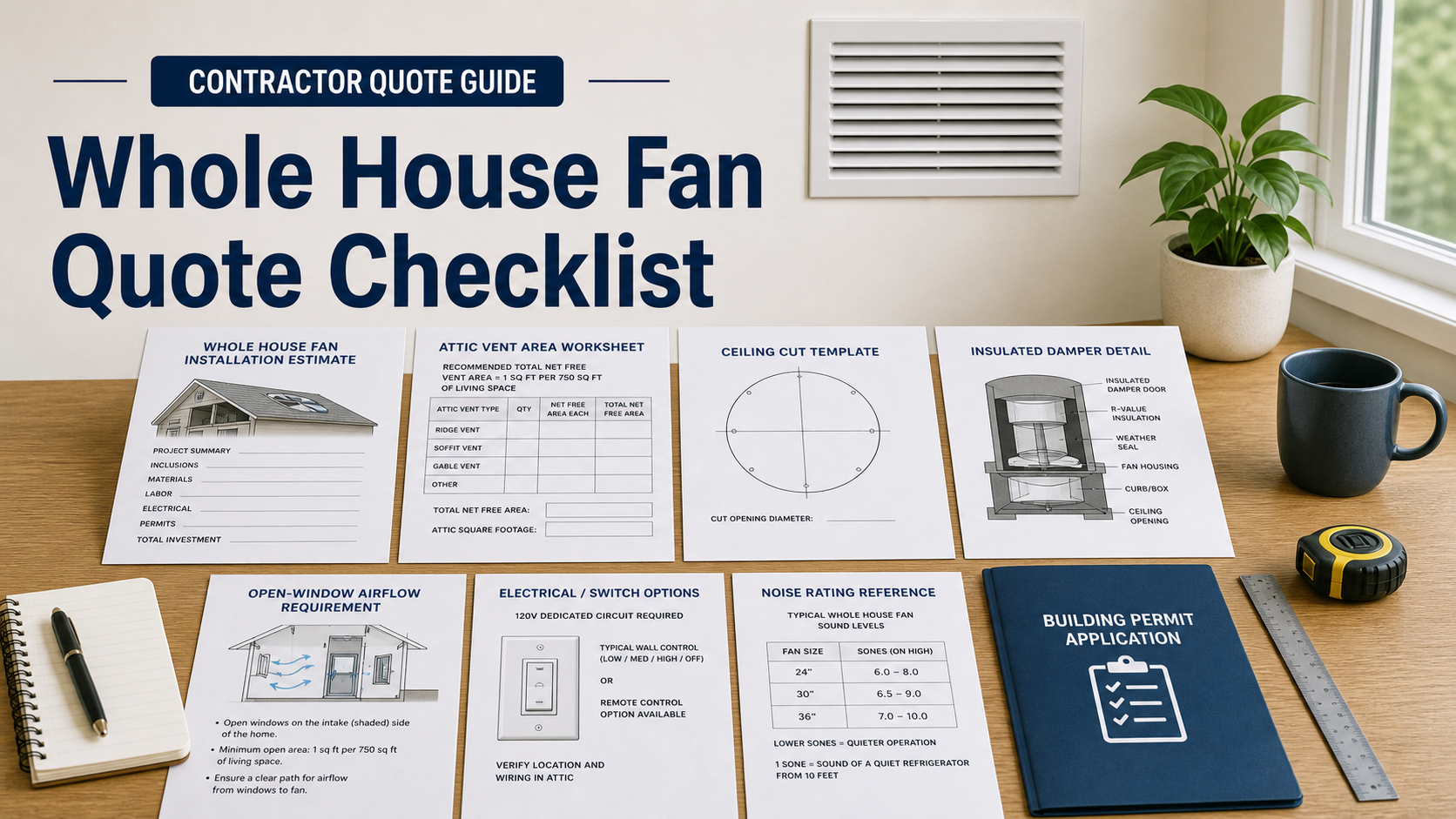
Short answer: approve a whole house fan quote only after it proves the system fits your climate and home layout, confirms enough attic exhaust vent area, shows the ceiling cut location, includes an insulated damper, defines electrical controls, addresses noise, and explains air sealing and permit responsibility.
A whole house fan can cool a home quickly when outdoor air is cooler than indoor air. It is not the same as an attic fan, and it is not a universal replacement for air conditioning.
Department of Energy guidance describes whole house fans as most useful where cool evening or nighttime outdoor air is available. That makes the estimate dependent on climate, window use, attic venting, and how well the fan seals when it is off.
Confirm The Home Is A Good Candidate
The quote should ask how the home will be used: whether windows can be opened safely, whether outdoor smoke or pollen is a frequent concern, whether evenings cool down, and whether household members are sensitive to outdoor air.
If the contractor sells the fan as an all-weather cooling system, slow down. A whole house fan works by pulling outdoor air through open windows and pushing warm indoor air into the attic and out through attic vents.
Check Attic Exhaust Vent Area
The estimate should calculate or verify the attic’s net free vent area. If the attic cannot exhaust the fan’s airflow, performance drops and pressure can create noise, dust movement, or attic moisture concerns.
Ask whether the quote includes adding roof, gable, ridge, or soffit venting if the existing attic ventilation is too small. The bid should not leave that decision until after the ceiling is cut.
Review The Ceiling Cut And Damper
The quote should show the fan location, framing clearance, access path, grille size, attic platform needs, and whether the installer will patch drywall or trim. It should also specify an insulated damper or shutter assembly that limits air leakage when the fan is off.
Air sealing matters because an unsealed fan opening can behave like a large attic leak during heating and cooling seasons. Ask how the installer will seal the fan frame to the ceiling plane.
Clarify Electrical Controls And Safety
The estimate should list the circuit, switch, timer, speed control, smart control if offered, permit and inspection responsibility, and shutdown instructions. Ask whether the fan has a timer or automatic shutoff so it is not left running after outdoor air warms up.
If the home has fuel-burning appliances, ask how the contractor evaluates pressure and backdrafting concerns. CPSC carbon monoxide guidance is not a whole-house-fan installation manual, but it is a reminder that combustion safety should not be ignored when a large exhaust fan changes house pressure.
Whole House Fan Quote Review Table
| Quote area | What to confirm | Why it matters |
|---|---|---|
| Climate fit | Cool evenings, window use, outdoor air concerns | The system depends on outdoor air being useful. |
| Attic venting | Net free vent area and added vent scope if needed | Air pulled indoors must leave the attic safely. |
| Ceiling opening | Location, framing, grille, drywall, trim, attic access | The cut affects appearance and repair scope. |
| Damper and air sealing | Insulated closure, sealed frame, winter leakage control | Poor sealing can waste energy when the fan is off. |
| Controls and safety | Timer, speed control, circuit, permit, combustion appliance check | Controls and pressure effects affect safe operation. |
Questions To Ask Before Approval
- Is this home in a climate where a whole house fan will be useful?
- How much attic net free vent area is available now?
- Does the quote include adding attic vents if needed?
- Where exactly will the ceiling opening and grille go?
- Is the damper insulated and sealed when the fan is off?
- What noise rating or sound expectation is provided?
- What electrical work, timer, switch, and permit are included?
- Are drywall repair, trim, attic platform, and cleanup included?
- How should the fan be operated around fireplaces or fuel-burning appliances?
Red Flags In A Whole House Fan Estimate
- The contractor does not calculate attic exhaust vent area.
- The quote does not include an insulated damper or air sealing detail.
- The installer cannot explain the difference between a whole house fan and an attic fan.
- Electrical controls and permit responsibility are vague.
- Noise expectations are not discussed before the ceiling is cut.
- The contractor ignores outdoor smoke, pollen, humidity, or combustion appliance concerns.
Quote check: a whole house fan estimate should prove the air path from window to attic to outdoors, not just list fan capacity.
Source Links
- Department of Energy: Cooling With a Whole House Fan
- Department of Energy: Ventilation
- Department of Energy: Air Sealing Your Home
- EPA: Ventilation and Indoor Air Quality
- CPSC: Carbon Monoxide Information Center
FAQ
Is a whole house fan the same as an attic fan?
No. A whole house fan pulls outdoor air through living spaces and exhausts it through the attic. An attic fan primarily ventilates attic air.
Does a whole house fan need attic vents?
Yes. The attic needs enough exhaust vent area for the fan’s airflow. The quote should verify this before installation.
Should the fan include an insulated damper?
Yes. The opening should seal when the fan is off so it does not become a major attic air leak.
Can a whole house fan affect indoor air quality?
It can, because it brings outdoor air indoors. Smoke, pollen, humidity, and outdoor pollutants should be considered before choosing the system.
Should electrical work be separate?
It can be, but the quote should say so. Circuit, switch, timer, permit, and inspection responsibility should be clear before approval.