
Short answer: Approve a home battery storage quote only after it defines the loads and outage duration to be supported, states both power and usable energy, identifies compatible battery, inverter, transfer and control equipment, confirms location and fire-safety requirements, includes panel and wiring work, permits and utility interconnection, commissioning and outage tests, monitoring access, warranty, and end-of-life responsibility.
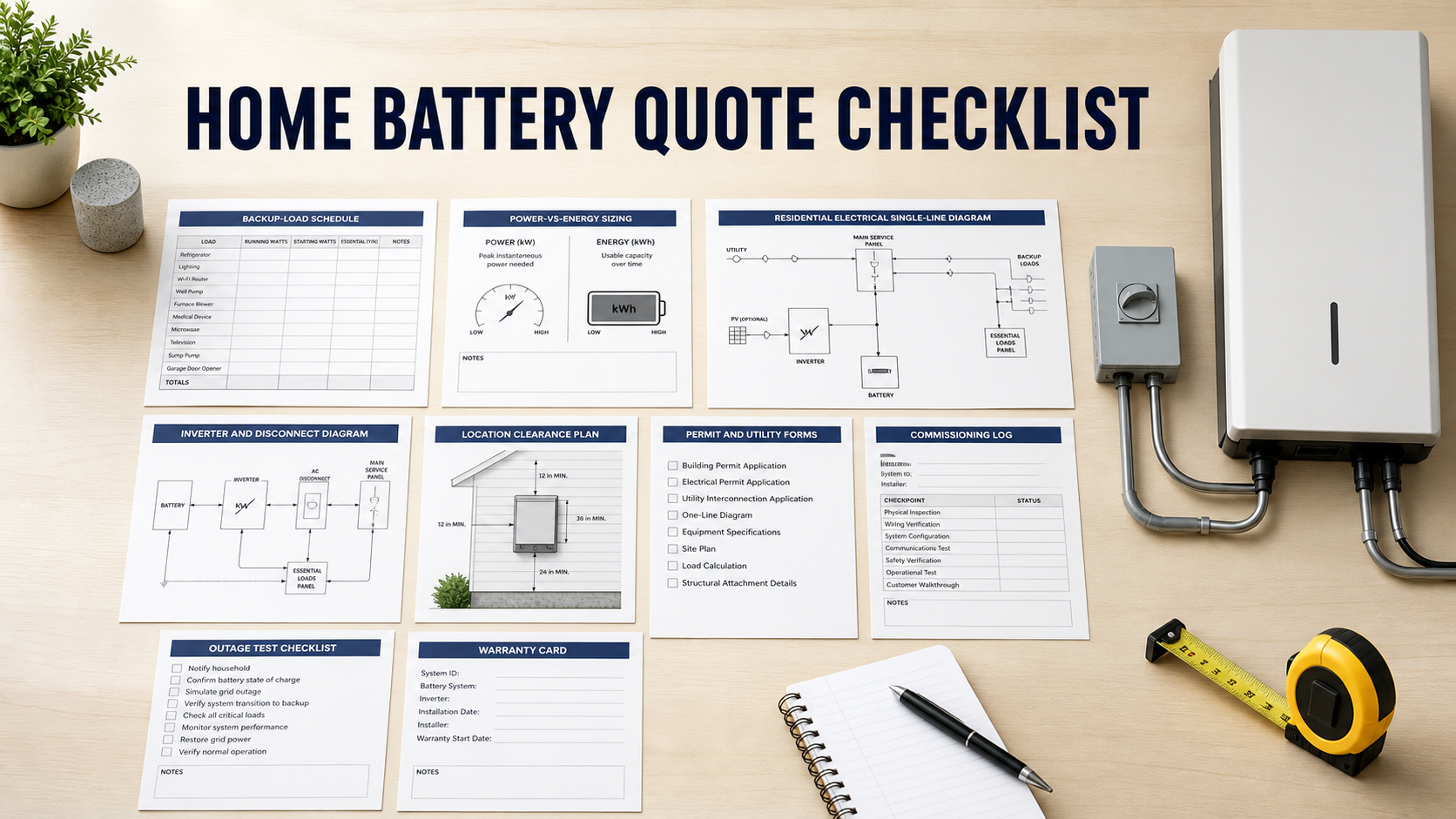
A battery advertised by one capacity number may not meet the homeowner's real backup goal. Power determines what can run at once, while usable energy affects how long selected loads can run; the quote must state both and show the assumptions behind the estimate.
Do not compare proposals until they use the same backup-load list, outage scenario, solar relationship, and electrical scope. One installer may include a critical-loads panel, service upgrade, utility application, permits, monitoring setup, and commissioning while another excludes them.
Translate Backup Goals Into A Load Schedule
List each supported circuit or appliance, starting and running demand, expected hours, and which loads must not operate together. Separate essential backup from optional whole-home claims and document any manual load management required.
Ask how heating, cooling, well pumps, sump pumps, refrigeration, medical needs, cooking, EV charging, and other large loads affect the design. The quote should not promise duration without stating the load profile used.
Compare Power, Energy, And Expansion
The proposal should state continuous and surge power, nominal and usable energy, operating reserve, expected backup duration for the agreed load, and how solar can recharge during an outage. NREL notes that residential storage cost and design depend on both power capacity and energy capacity.
If expansion is promised, record compatible modules, inverter limits, space, conduit, software, permit implications, and whether adding capacity later changes warranty or utility approval.
Review Location And Safety Requirements
Show the exact indoor or outdoor location, mounting surface, clearances, temperature and weather limits, vehicle-impact protection, flood exposure, ventilation or enclosure needs, working space, and emergency access. DOE advises checking local building, fire, and electrical requirements for battery storage.
Battery systems should be listed and installed as a complete compatible system under applicable codes. CPSC materials document overheating and fire hazards in high-energy batteries, so do not accept mismatched cells, improvised modules, or undocumented chargers and controls.
Define The Electrical One-Line Scope
Require a single-line diagram showing battery, inverter, gateway or transfer equipment, service equipment, critical-loads panel if used, disconnects, overcurrent protection, grounding, communications, and solar connection. List panel, meter, service, conductor, conduit, wall, and trench work.
Confirm whether the design can island safely during an outage and how it reconnects to the grid. If a generator is also present, the quote must explain approved operating logic instead of assuming the sources can share a panel.
Assign Permit And Utility Responsibilities
The contract should name the party responsible for building, fire, and electrical permits, plan revisions, inspections, utility interconnection or notification, equipment registration, and permission to operate when required. Record fees and schedule dependencies.
Do not schedule final payment before required inspection and utility steps are complete. A physically installed battery may still be unavailable for normal operation if approvals or settings remain unfinished.
Require Commissioning, Outage Testing, And Service Records
Commissioning should verify wiring and protection, communications, firmware, operating modes, charge and discharge, transfer behavior, solar interaction, backup circuits, alarms, shutdown, and homeowner controls. Run an agreed outage simulation rather than relying on a dashboard screenshot.
Closeout should include permits, one-line and equipment locations, serial numbers, settings, test results, manuals, emergency shutdown instructions, monitoring ownership, recall contact, workmanship and equipment warranties, capacity-retention terms, service response, and recycling or disposal path.
Home Battery Storage Scope Comparison
| Quote area | What to confirm | Why it matters |
|---|---|---|
| Backup objective | Critical loads, starting demand, simultaneous use, hours, outage scenario, and manual limits | Defines what the battery is expected to support |
| Sizing | Continuous and surge power, usable energy, reserve, duration model, recharge, and expansion | Prevents one capacity number from hiding performance limits |
| Equipment and location | Compatible listed system, mounting, clearances, temperature, flood, impact, and emergency access | Connects product choice to safe installation conditions |
| Electrical work | One-line, transfer equipment, critical-loads panel, service or panel work, disconnects, conduit, and grounding | Shows the complete installed system rather than only the battery cabinet |
| Approvals | Building, fire, electrical, utility, inspections, plan revisions, and permission to operate | Assigns responsibility for every external gate |
| Commissioning and warranty | Outage test, modes, monitoring, shutdown, test report, capacity terms, service, recalls, and end of life | Proves operation and preserves a support path |
Questions To Ask Before Approval
- Which circuits and appliances are included in the backup-load schedule?
- What continuous power, surge power, usable energy, and modeled duration are promised?
- How does solar recharge work during a grid outage?
- Why is the proposed location compliant and protected from heat, water, impact, and blocked access?
- What panel, service, transfer, wiring, conduit, and generator coordination work is included?
- Who handles permits, inspections, utility approval, and plan revisions?
- Which outage tests, records, monitoring rights, warranties, recall response, and end-of-life duties are included?
Red Flags In This Quote
A whole-home backup claim with no circuit list, starting loads, simultaneous-use rules, or duration assumptions is not an engineering scope.
A quote that lists a battery cabinet but omits transfer equipment, panel work, disconnects, conduit, permits, and utility tasks is not the installed price.
An installer who cannot explain emergency shutdown, monitoring ownership, recall communication, capacity warranty, and service response leaves the homeowner with no operational support plan.
Source Links
- Department of Energy solar guide with residential battery considerations
- NREL residential battery storage system overview
- CPSC high-energy-density battery fire standards work
FAQ
What is the difference between battery power and energy?
Power describes how much demand the system can support at a moment, while energy describes how much stored electricity is available over time. Both are needed to evaluate backup performance.
Will a home battery run central air conditioning?
It depends on starting and running demand, inverter power, battery configuration, other simultaneous loads, and the approved design. The quote should model the exact equipment rather than make a general promise.
Can solar panels recharge the battery during an outage?
Some properly designed systems can, but islanding controls, inverter compatibility, battery limits, solar production, and load management determine the result. Require the operating mode in writing and test it.
Where can a residential battery be installed?
Allowed locations and clearances depend on the listed equipment, manufacturer instructions, building, fire and electrical rules, climate, flood and impact exposure, and local authority approval.
What should happen during commissioning?
The installer should verify protection, settings, communications, charge and discharge, transfer, supported circuits, solar behavior, alarms, shutdown, monitoring, and an agreed outage simulation, then provide the test record.
Related Contractor Quote Guide Guides
- Solar panel installation quote checklist
- Whole house generator quote checklist
- Electrical panel upgrade quote checklist
A home battery quote is complete when the backup goal, power and energy model, safe location, one-line diagram, approvals, outage test, monitoring, service, and end-of-life plan all describe one operable system.