
Short answer: A brick repointing quote should map failed joints and moisture causes, identify brick condition, document existing mortar properties and a compatible replacement mix, define joint-removal tools and depth, protect brick edges, clean and pre-dampen joints, build and approve a sample panel, place mortar in controlled lifts, match joint profile and color, set temperature and weather limits, cure slowly, use gentle cleaning, protect occupants and adjacent finishes, price access and selective brick replacement, and provide photos, material records, inspection, and warranty.
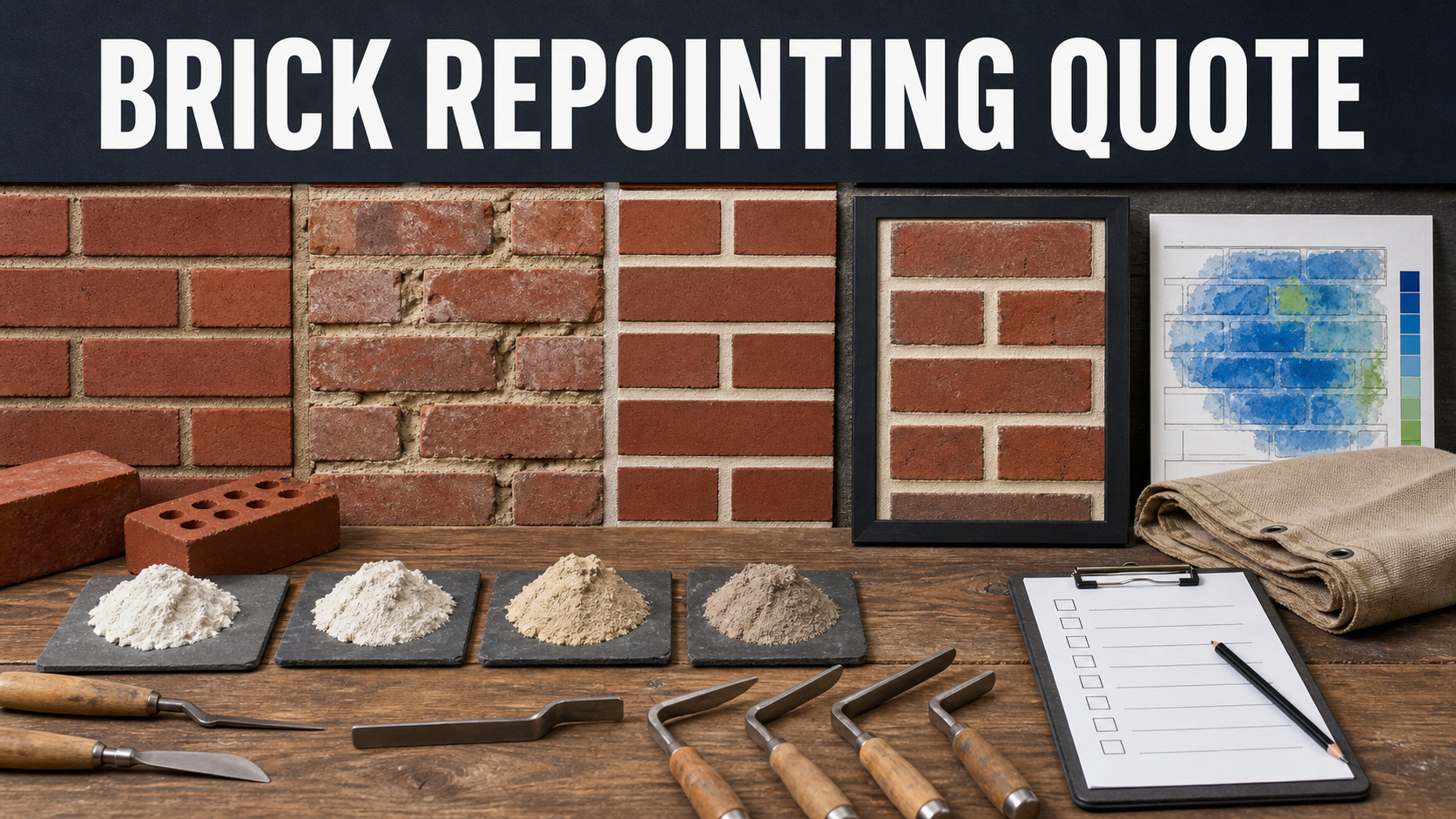
Repointing is not the same as smearing new mortar over an old joint. National Park Service guidance emphasizes compatible mortar, adequate joint preparation, trial samples, skilled workmanship, controlled weather, curing, and gentle cleaning. An overly hard or impermeable mortar can accelerate damage in softer historic brick.
Normalize the same wall areas, access, mortar analysis, removal depth, sample panel, brick repairs, flashing or water-source corrections, weather protection, curing, cleaning, containment, and closeout. A bid for full-wall repointing is not directly comparable to selective repair, and the larger scope is not automatically the better one.
Map Deterioration And Water Sources
The proposal should mark open, eroded, cracked, loose, previous-repair, and sound joints by elevation. Note spalled brick, bulging, displacement, efflorescence, staining, failed sealant, leaking gutters, parapets, sills, copings, flashings, and rising or trapped moisture.
Repointing will not correct ongoing water entry or structural movement. Require separate recommendations and pricing for source corrections, engineering, brick replacement, lintel work, or reconstruction before new joints hide the evidence.
Match Mortar To The Masonry
State how the existing mortar is sampled and evaluated for binder, aggregate, color, texture, tooling, hardness, and vapor behavior. Historic work may need laboratory analysis or preservation review; modern walls still require compatibility with the brick and assembly.
The new mix should be weaker and more vapor-permeable than the masonry where appropriate, while meeting exposure and performance needs. Name cement, lime, sand source and grading, pigments, additives, proportions, batching, water, and documentation rather than accepting a generic Type S or Type N label without context.
Define Joint Removal And Preparation
Specify removal depth, limits at sound mortar, hand tools and narrowly controlled power tools, worker qualification, protection of brick arises, dust control, debris collection, and inspection before filling. Saw cuts that widen joints or chip brick are damage, not progress.
Require loose material to be removed, joints cleaned without harmful residue, and masonry pre-dampened to control suction. Joint preparation and hidden conditions should be photographed before new mortar conceals them.
Approve A Sample Panel Before Production
The sample panel should use the proposed removal, preparation, mortar, placement, tooling, curing, and final cleaning on a representative area. Review it only after the mortar has had time to develop color and texture.
Record the approved location and acceptance criteria for joint width, profile, compaction, texture, color range, brick-edge preservation, staining, and cleaning. The sample becomes the benchmark for the rest of the job.
Control Placement, Weather, And Curing
Describe lift thickness, compaction, timing between lifts, tooling when thumbprint hard, final brushing, and treatment at deep or irregular joints. Workers should not fill only the exposed face over loose material or deep voids.
Set acceptable wall temperatures, shade, wind and rain protection, cold-weather plan, hot-weather plan, damp curing method, duration, and daily production limits. NPS guidance notes that moderate wall temperatures and slow drying help mortar cure properly.
Clean Gently And Close Out The Work
Define when and how smears are removed, the gentlest approved cleaner, test areas, rinse control, protection of glass, metal, plants, roofs, and paving, and prohibited abrasive blasting or aggressive high-pressure washing. If coatings or lead-painted surfaces may be disturbed, assign applicable containment and certified-work requirements.
Closeout should include elevation photos, mortar batch logs, sample approval, repaired quantities, brick replacement records, weather and curing logs, cleaning acceptance, permit or preservation approval, leftover labeled materials, maintenance guidance, and workmanship warranty.
Normalize Repointing Proposals
Normalize The Survey
Use One Elevation Map
Give bidders the same joint areas, access heights, brick damage, prior repairs, and water-source observations.
Use One Repair Boundary
Separate selective repointing, full-wall work, brick replacement, structural repair, and water corrections.
Normalize The Method
Use One Mortar Basis
Compare analysis, binder, lime, sand, pigment, proportions, performance, color, and documentation.
Use One Sample Standard
Approve removal, depth, preparation, placement, tooling, curing, and cleaning on one representative panel.
Normalize Evidence
Use One Photo Set
Require condition maps, prepared joints, concealed work, sample, production, cleaning, and final elevations.
Use One Closeout List
Collect batch and weather logs, quantities, approvals, maintenance guidance, and warranty.
Brick Repointing Quote Comparison Table
| Quote area | What to confirm | Why it matters |
|---|---|---|
| Condition | Joint map, brick damage, movement, water sources, prior repairs | Separates symptoms from causes |
| Mortar | Analysis, binder, lime, sand, pigment, proportions, compatibility | Protects brick and matches appearance |
| Removal | Depth, tools, brick-edge protection, dust collection | Prevents irreversible masonry damage |
| Preparation | Cleaning, loose material, pre-dampening, inspection photos | Supports bond and full-depth repair |
| Sample | Representative panel, cure time, profile, color, texture, cleaning | Creates an objective quality benchmark |
| Weather | Temperature, shade, rain, wind, cold, heat, curing | Controls strength, color, and shrinkage |
| Access | Scaffold, lifts, protection, public and occupant control | Exposes major cost and safety assumptions |
| Closeout | Photos, batches, quantities, logs, approvals, warranty | Documents what was actually repaired |
Questions To Ask Before Approval
- Which joints and elevations need work, and which remain sound?
- What water-entry or movement causes must be corrected first?
- How will existing mortar and brick be evaluated for compatibility?
- What exact mortar ingredients and proportions are proposed?
- What joint-removal tools, depth, and brick-edge protections are included?
- How are joints cleaned, inspected, and pre-dampened?
- Where will the sample panel be built and when will it be approved?
- Which joint profile, texture, and color range define acceptance?
- What temperature, rain, sun, wind, and curing limits apply?
- How are dust, runoff, lead-painted surfaces, landscaping, and adjacent finishes protected?
- How are brick replacement and hidden voids priced and approved?
- Which batch logs, photos, maintenance instructions, and warranties are delivered?
Red Flags In This Quote
The proposal specifies a high-strength mortar without evaluating the existing brick and mortar.
Workers will grind joints with no stated depth, blade control, brick-edge limit, or sample.
New mortar will be applied over shallow or loose material without full preparation.
No temperature, weather, damp-curing, or gentle-cleaning procedure is included.
The contractor proposes waterproof coating as a default substitute for correcting moisture sources.
Source Links
- NPS Preservation Brief 2: Repointing Mortar Joints
- NPS Preservation Briefs Index
- NPS: Sharing The Mysteries Of Mortar
- EPA: Renovation, Repair And Painting Work Practices
FAQ
What is the difference between repointing and tuckpointing?
Repointing replaces deteriorated mortar in prepared joints. Tuckpointing can refer to a decorative two-color joint technique, although the terms are often used loosely. The proposal should describe the actual method.
Should every joint be replaced?
Not automatically. Sound compatible mortar can remain. Selective or full-wall work should follow condition mapping, access economics, weather exposure, and expected service life.
Why can strong mortar damage old brick?
If mortar is harder or less permeable than soft brick, moisture and stress may be forced through the masonry units, contributing to spalling and deterioration.
Why is a sample panel important?
It demonstrates removal, mortar, color, texture, joint profile, curing, and cleaning on the actual wall before the contractor proceeds across a large area.
Can repointing stop every leak?
No. Roofs, flashings, copings, sills, gutters, sealant joints, rising moisture, and structural cracks may require separate correction.
What evidence should be delivered?
Request condition and completion photos, sample approval, mortar recipe and batch logs, weather and curing records, repaired quantities, approvals, cleaning acceptance, maintenance guidance, and warranty.
Related Contractor Guides
- Masonry Crack Repair Quote
- Exterior Wall Water Intrusion Quote
- Chimney Repair Quote Checklist
- Scaffold And Access Cost In Contractor Quotes
Good repointing sacrifices compatible mortar to protect the brick; a quote should prove the contractor understands that relationship before any joint is cut.