
Short answer: approve a wood stove installation quote only after it identifies the exact certified heater, local permit path, manufacturer installation manual, clearance-to-combustibles plan, chimney or liner scope, hearth protection, carbon monoxide alarm requirements, insurance notice, and final inspection responsibility.
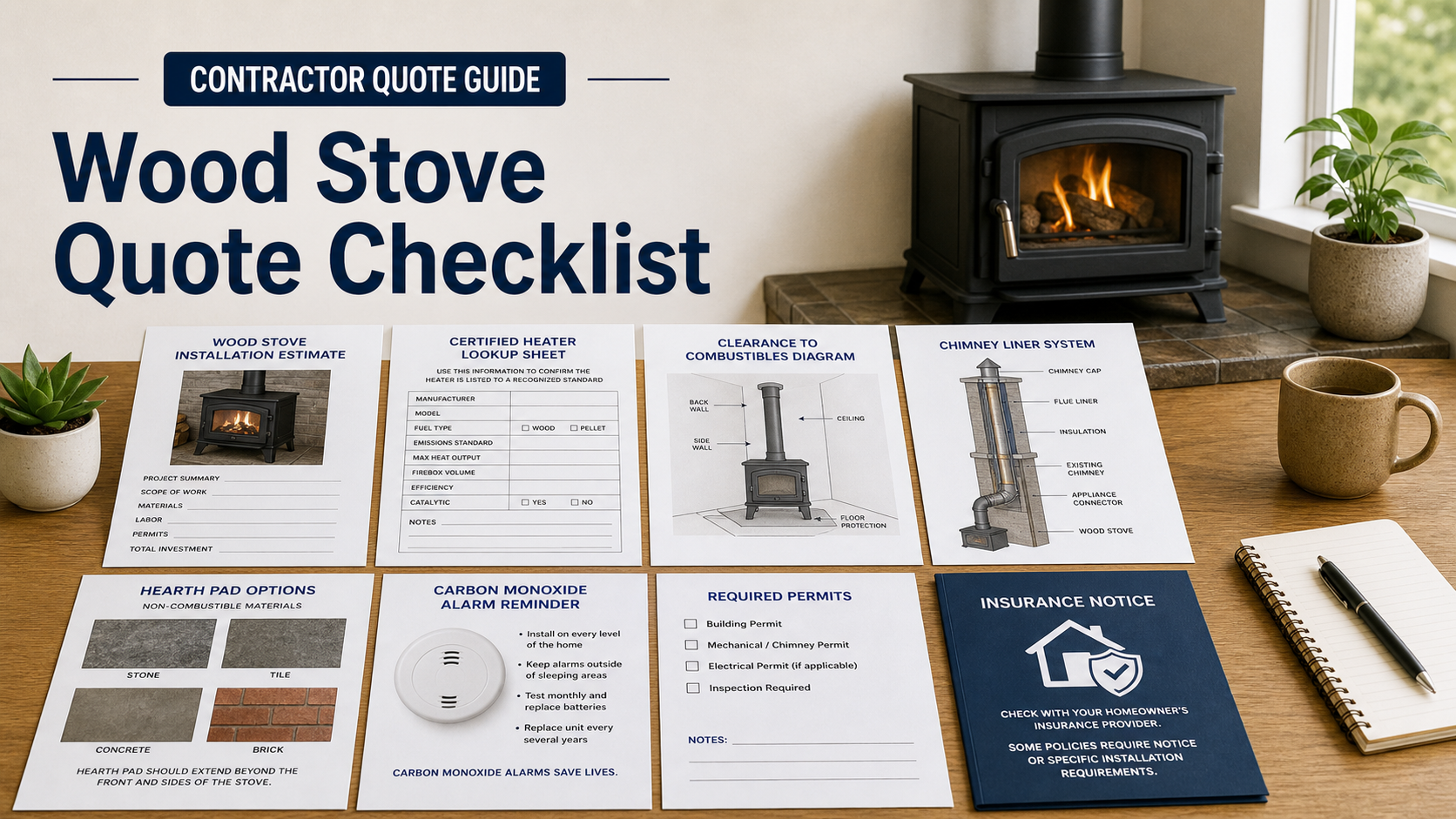
A wood stove installation is a heating and fire-safety project, not just an appliance delivery. The quote should tell you exactly what stove is being installed, how it connects to the chimney, and how the installer will prove the system meets local requirements.
EPA maintains certified wood-heater information, and older Burn Wise pages remain useful background, but EPA also notes that some Burn Wise content is no longer being updated. Treat those pages as references and verify current installation requirements through the local authority, manufacturer manual, and permit process.
Verify The Exact Stove Before Approval
The estimate should include the stove manufacturer, model, fuel type, emissions certification status, heat output range, required clearances, and installation manual reference. Ask the contractor to match the quoted model against EPA certified heater information or current manufacturer documentation.
Do not approve a quote that says “EPA stove included” without a model number. The wrong appliance or missing manual can create inspection, warranty, and insurance problems.
Review Clearances And Hearth Protection
The quote should show clearance-to-combustibles for rear, side, corner, floor, wall, mantel, and nearby trim conditions. It should also specify hearth pad size, material, ember protection, thermal protection if needed, and whether wall shields or heat shields are included.
Clearances are not decoration. They are safety requirements tied to the listed appliance and installation manual. Field changes after delivery can become expensive if the stove does not fit the chosen location.
Separate Chimney, Flue, And Liner Work
The chimney scope should be written clearly: existing chimney inspection, cleaning, flue size, liner type, connector pipe, thimble, roof penetration, flashing, cap, spark arrestor if required, and any masonry or roof repair.
If the quote assumes the existing chimney is usable, ask what happens if inspection shows an unsafe flue, wrong diameter, cracks, missing liner, or clearance problem.
Confirm Permit, Insurance, And Alarm Requirements
The quote should state who pulls the permit, who schedules inspection, and what documentation the homeowner receives. Ask your insurer whether the installation must be reported before use.
USFA and CPSC safety materials emphasize fire prevention and carbon monoxide awareness around heating equipment. The quote should address smoke alarms, carbon monoxide alarms, floor protection, owner operation instructions, and annual chimney maintenance.
Wood Stove Quote Review Table
| Quote area | What to confirm | Why it matters |
|---|---|---|
| Appliance | Exact model, certification, manual, fuel type | The installation requirements come from the listed unit. |
| Clearances | Combustible walls, trim, furniture, mantel, floor, shielding | Clearance mistakes can fail inspection and create fire risk. |
| Chimney | Inspection, liner, connector pipe, cap, flashing, masonry repairs | The chimney is part of the heating system. |
| Hearth protection | Pad size, material, ember and thermal protection | The floor system must match the appliance manual. |
| Compliance | Permit, final inspection, insurance notice, alarm requirements | Documentation protects occupancy, coverage, and resale records. |
Questions To Ask Before Approval
- What exact stove model is included, and where is its installation manual?
- Is the unit listed in current EPA or manufacturer documentation?
- What clearances are required for the chosen location?
- Will wall shields, floor protection, or hearth expansion be needed?
- Has the existing chimney been inspected for size, liner, condition, and clearance?
- Is chimney cleaning, relining, cap work, flashing, or masonry repair included?
- Who pulls the permit and schedules final inspection?
- What smoke and carbon monoxide alarm work is included or excluded?
- Does the homeowner need to notify insurance before using the stove?
Red Flags In A Wood Stove Estimate
- The quote has no model number or installation manual reference.
- Clearances are discussed verbally but not drawn or measured.
- The existing chimney is assumed safe without inspection.
- Hearth protection is described as “standard” without material or size.
- Permit and inspection responsibility are missing.
- Carbon monoxide alarms and owner operation instructions are not addressed.
Quote check: a safe wood stove estimate should be appliance-specific, chimney-specific, and inspection-ready before any pipe is installed.
Source Links
- EPA: Certified Wood Heater Database
- EPA Burn Wise: EPA Certified Wood Stoves
- EPA Burn Wise: Wood-Burning Installation and Maintenance
- CPSC: Home Heating Equipment and Carbon Monoxide
- USFA: Fireplace and Wood Stove Safety Card
FAQ
Should a wood stove quote include the model number?
Yes. The model number is needed to verify certification, clearances, manual requirements, parts, and warranty terms.
Can I use an existing chimney?
Possibly, but the chimney should be inspected for condition, liner, size, and compatibility before the quote assumes it is ready.
Does a wood stove need a permit?
Many areas require a permit and final inspection. The quote should identify who handles both under local rules.
Are carbon monoxide alarms part of the job?
They should at least be addressed. The quote should say whether alarm installation is included, excluded, or handled separately.
Should I tell my insurance company?
Ask your insurer before using the stove. Some policies require notice, inspection proof, or documentation for solid-fuel appliances.