
Compare an AFCI and GFCI retrofit quote by requiring a room-by-room circuit survey, the locally adopted code and permit basis, a written map of which circuits receive arc-fault, ground-fault, or combined protection, panel and breaker compatibility, shared-neutral and multiwire-branch-circuit review, grounding and box-condition checks, a clear choice between breaker and receptacle devices, nuisance-trip troubleshooting boundaries, safe shutdown, functional testing, labeling, inspection, and owner instructions. Do not accept a device count without a circuit map and a rule for wiring defects discovered during installation.
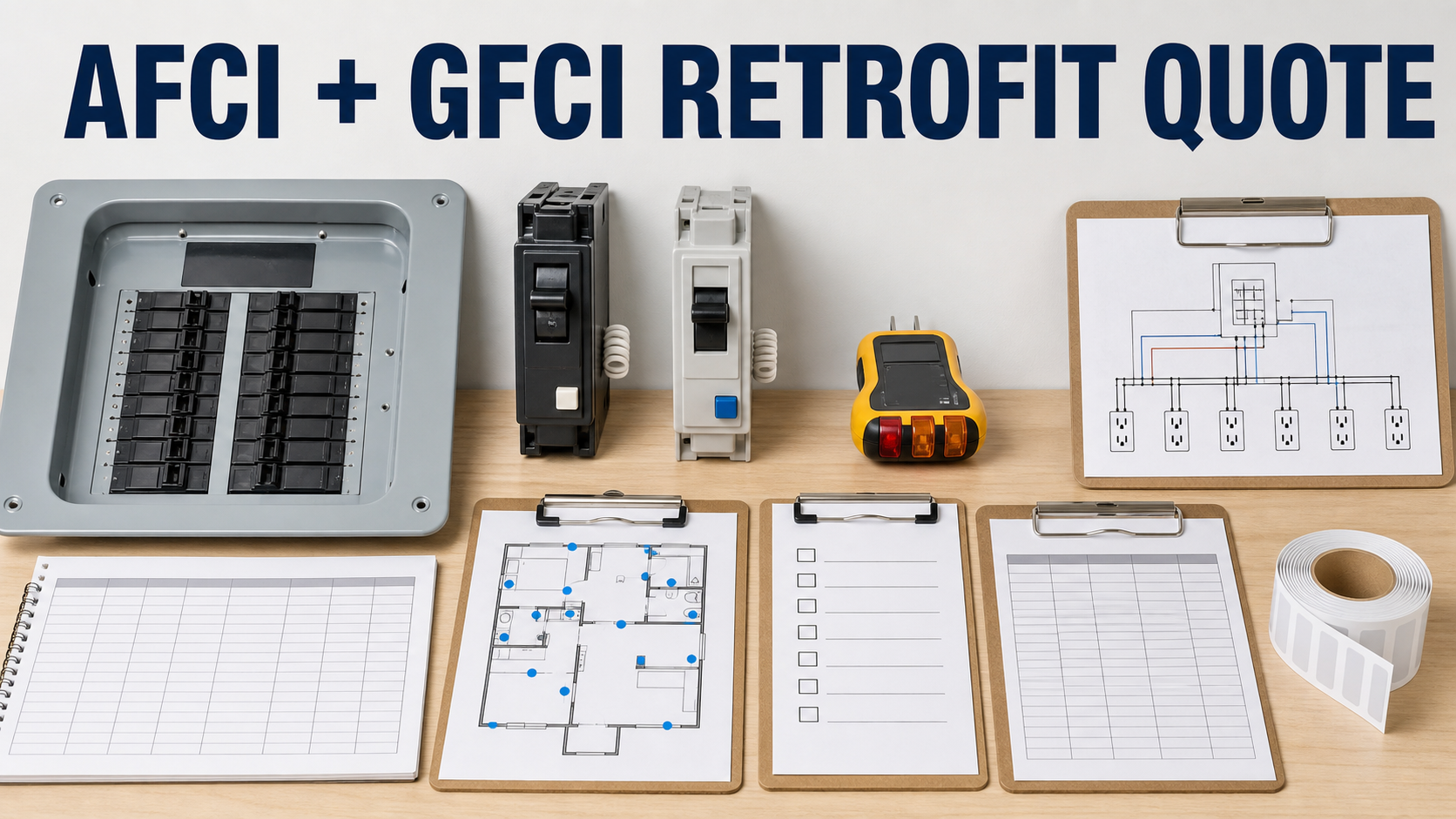
Two proposals can list the same number of devices while protecting different downstream outlets and leaving different wiring conditions unresolved. Older panels, shared neutrals, bootleg grounds, reversed polarity, damaged insulation, crowded boxes, and undocumented additions can change both the design and the amount of troubleshooting required.
AFCI and GFCI are not interchangeable labels. Ground-fault protection is intended to reduce shock risk, while arc-fault protection addresses hazardous arcing; the required locations, device types, and combination rules depend on the adopted code, local amendments, existing wiring, and the authority having jurisdiction.
Map Every Circuit Before Counting Devices
Require a circuit directory verified at outlets, lights, fixed appliances, outdoor equipment, garage, basement, crawl space, laundry, kitchen, bathrooms, bedrooms, additions, and detached structures. The survey should record circuit voltage, breaker size, conductor type, grounding path, neutral arrangement, protected downstream points, and any area that could not be safely accessed.
The proposal should distinguish a complete survey from a limited visual inspection. Unknown junctions, mislabeled breakers, inaccessible boxes, abandoned wiring, and circuits that serve more than one area should be listed as uncertainties with a defined investigation or change-order process.
State The Protection Rule For Each Location
List each circuit or outlet that will receive GFCI, AFCI, or dual-function protection and cite the locally adopted requirement or voluntary safety objective. Do not rely on a generic statement such as bring the house up to code because existing-work triggers and local amendments vary.
CPSC explains that GFCIs monitor imbalance and interrupt power rapidly to reduce severe shock risk, especially near water and other vulnerable areas. CPSC also describes AFCIs as protection against hazardous arcing in damaged wiring or connections. The quote should connect those functions to the actual circuit map.
Confirm Panel And Device Compatibility
Record the panel manufacturer and model, main rating, available spaces, breaker types, bus and enclosure condition, working clearance, signs of overheating or corrosion, and whether the proposed protective breaker is specifically compatible with that panel. Substitution by physical fit alone is not an acceptable scope statement.
If the panel cannot accept the planned devices, the quote should separate approved alternatives such as receptacle-level protection, an allowed upstream device, a subpanel, or panel work. Required panel replacement or repair must be priced as a distinct decision, not discovered after every room is opened.
Inspect Neutrals, Grounds, And Existing Faults
Ask how the electrician will identify shared neutrals, multiwire branch circuits, neutral-to-ground connections downstream of the service, reversed polarity, open grounds, bootleg grounds, damaged conductors, loose splices, aluminum conductors, and incompatible cable or box conditions. Protective devices may reveal defects that standard breakers did not show.
The bid should define which corrections are included, which require authorization, and which conditions stop work. It should never imply that a new device makes an unsafe grounding, bonding, splice, or conductor condition acceptable.
Choose Breaker, Receptacle, Or Dual-Function Protection Deliberately
For every protected run, identify device location, upstream and downstream coverage, line and load connections, accessibility for testing, reset location, enclosure and weather rating, compatibility with appliances, and the effect of one trip on lighting, refrigeration, alarms, pumps, or essential equipment. A hidden reset point can turn a routine trip into a service call.
Where a dual-function device is proposed, document both intended functions and the diagnostic process for a trip. Where separate devices are used, show their order and coordination so the homeowner can understand which device operated and what remains energized.
Define Installation, Access, And Restoration
Specify shutdowns, occupant notice, lockout practices, furniture or appliance movement, panel access, outlet and switch removal, box extensions, cover plates, weatherproof covers, drywall or finish openings, dust control, debris removal, patching, painting, and restoration exclusions. Only qualified personnel should work inside energized electrical equipment.
List hidden-condition rules for overcrowded boxes, short conductors, brittle insulation, damaged devices, inaccessible junctions, wet locations, failed equipment, and circuits that cannot be isolated. The homeowner should know the decision point before the electrician starts opening multiple rooms.
Test The Entire Protected Path
Require controlled energization, manufacturer test-button checks, correct trip and reset behavior, outlet polarity and downstream protection checks, breaker handle and directory verification, affected-light and appliance checks, and inspection signoff. CPSC advises periodic testing because a protective device can fail without an obvious outward sign.
The closeout record should identify every installed device, the circuit and locations it protects, test results, observed wiring limitations, corrections made, unresolved exclusions, permit and inspection status, and photographs that do not expose private account or occupant information.
Plan For Trips, Maintenance, And Warranty
The handoff should explain safe monthly or manufacturer-directed testing, reset steps, indicators, what to unplug before troubleshooting, when repeated trips require an electrician, and how to avoid defeating protection. A trip is a signal to diagnose, not permission to swap in an ordinary breaker or bypass the device.
Separate labor, device, and callback warranties. Record registration, proof requirements, exclusions for existing wiring or connected equipment, response time, who pays for diagnostic visits, and whether a corrected wiring defect resets the workmanship period.
Review The Quote From Circuit Map To Test Log
Prove The Design Fits The House
Trace The Protected Boundary
Match every breaker or receptacle device to the rooms, outlets, lights, fixed loads, downstream points, and reset location it will actually protect.
Expose Wiring Conditions Early
Document shared neutrals, grounding, polarity, panel compatibility, conductor condition, inaccessible work, and stop-work triggers before pricing corrections.
Prove The Finished Protection Works
Test Function And Coverage
Verify test buttons, trips, resets, polarity, downstream coverage, affected loads, labels, directory, permit, inspection, and unresolved limitations.
Make Future Trips Understandable
Give the homeowner device locations, testing instructions, safe troubleshooting steps, warranty terms, and a clear rule for repeated or unexplained trips.
AFCI And GFCI Retrofit Quote Comparison
| Quote area | What to confirm | Why it matters |
|---|---|---|
| Circuit survey | Rooms, outlets, lights, fixed loads, breaker size, conductor, neutral, ground, downstream coverage, access, and unknowns | Prevents a device count from hiding incomplete coverage |
| Protection basis | Adopted code, local amendments, permit, inspection, and each circuit marked AFCI, GFCI, dual-function, or excluded | Separates different safety functions and local requirements |
| Compatibility | Panel model, listed breaker fit, spaces, bus condition, shared neutrals, multiwire circuits, box depth, grounding, and polarity | Finds conditions that change device choice or scope |
| Installation | Breaker or receptacle location, line/load boundary, reset access, shutdown, openings, covers, restoration, and hidden-condition rules | Makes labor and disruption comparable |
| Acceptance | Test buttons, trip and reset, polarity, downstream points, affected loads, directory, labels, inspection, photos, and test log | Provides objective completion evidence |
| Ownership | Testing interval, safe trip response, callback rules, device and labor warranties, exclusions, and unresolved wiring limits | Keeps protection usable after the installer leaves |
Questions To Ask Before Approval
- Which exact circuits and downstream outlets, lights, and fixed loads receive AFCI, GFCI, or dual-function protection?
- Which adopted code, local amendment, permit, inspection, and existing-work trigger support that scope?
- How were panel compatibility, breaker spaces, bus condition, shared neutrals, multiwire circuits, grounding, and polarity checked?
- Where will each device be installed and reset, and what remains energized when it trips?
- Which wiring defects and box or panel corrections are included, optional, or stop-work conditions?
- How are shutdown, room access, device removal, openings, covers, cleanup, patching, and restoration handled?
- Which tests prove trip, reset, polarity, downstream coverage, affected-load operation, labels, and inspection closure?
- What testing, trip troubleshooting, callback, labor warranty, device warranty, and unresolved-condition instructions will I receive?
Red Flags In This Quote
A single device count with no circuit map can hide unprotected downstream points, inaccessible reset locations, or double-counted circuits.
A promise to eliminate nuisance trips without first testing wiring, neutrals, loads, and device placement may lead to unsafe bypasses or repeated callbacks.
A compatible-looking breaker is not enough; the proposal should identify the panel and approved device family and document existing panel defects separately.
Primary References & Homeowner Resources
- U.S. Consumer Product Safety Commission GFCI fact sheet
- U.S. Consumer Product Safety Commission AFCI fire-prevention guide
- U.S. Consumer Product Safety Commission home electrical safety checklist
- U.S. Fire Administration appliance and electrical fire safety
FAQ
Are AFCI and GFCI the same thing?
No. GFCI protection responds to current leaking from the intended path to reduce shock risk, while AFCI protection is designed to detect hazardous arcing conditions. A circuit may require one or both functions.
Can one GFCI receptacle protect other outlets?
It can protect correctly connected downstream outlets, but the quote should map that boundary, label the protected points, and place the reset where it remains accessible.
Why can a retrofit reveal new trip problems?
Protective devices can expose shared-neutral errors, neutral-ground connections, damaged insulation, moisture, appliance leakage, miswiring, or arcing that an ordinary breaker did not identify.
Should every device be installed in the panel?
Not automatically. Panel compatibility, circuit arrangement, reset access, downstream coverage, box condition, and local rules determine whether breaker, receptacle, or combined protection is appropriate.
How should the finished work be tested?
Use manufacturer test functions, controlled trip and reset checks, polarity and downstream coverage verification, affected-load checks, labels, directory updates, and required inspection.
What should I do if the new protection keeps tripping?
Do not bypass it. Record when and what was operating, unplug loads only when safe, follow the owner instructions, and call the electrician for repeated, unexplained, warm, damaged, or non-resetting conditions.
Related Home Repair & Remodel Guides
- Electrical panel upgrade quote checklist
- Whole-house rewiring quote checklist
- Whole-house surge protection quote checks
An AFCI and GFCI retrofit quote is ready when every protected circuit, wiring assumption, device location, correction rule, acceptance test, and owner instruction can be checked before approval.