
Short answer: Compare a heat pump water heater installation quote by requiring a household hot-water and first-hour-rating assessment, the exact operating modes, a location with enough free air and suitable temperature, intake and exhaust clearances, sound planning, a gravity condensate route or maintained pump, drain pan and leak response, compatible dedicated electrical supply, plumbing and pressure-relief discharge, structural and seismic support where required, safe removal of the old fuel or electric unit, startup measurements, owner controls, filter and condensate maintenance, permit closure, and warranty. A high-efficiency tank in a cramped closet without an approved airflow and drainage plan is not a complete retrofit.
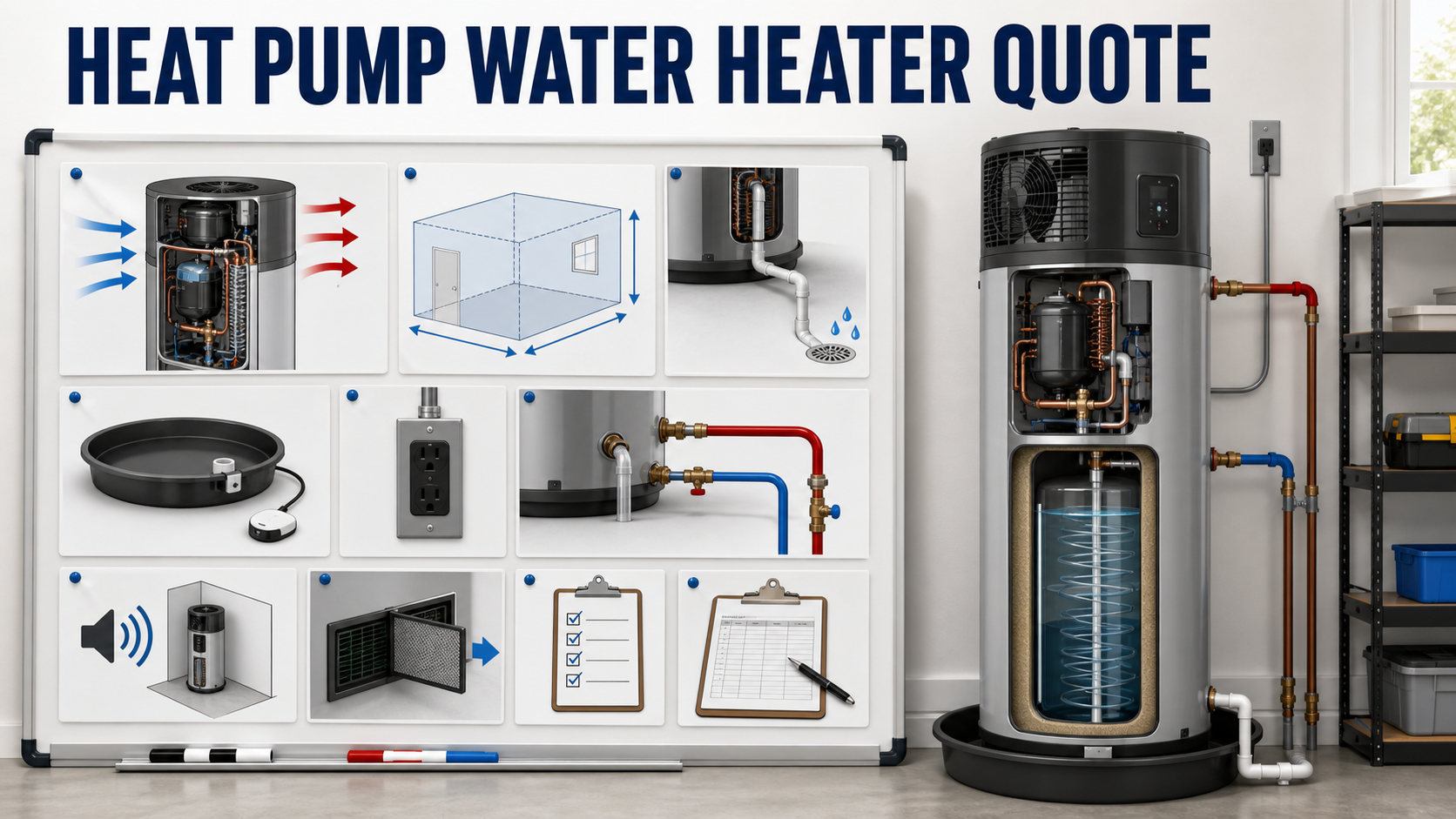
Heat pump water heaters move heat from the surrounding air into the tank, so the room becomes part of the appliance system. Two bids for the same tank can produce different comfort, noise, efficiency, condensate, and recovery results if one ignores room volume, climate, ducting, electrical capacity, or peak hot-water use.
Do not compare only tank gallons or an advertised efficiency number. Household draw pattern, first-hour rating, backup resistance use, installation temperature, free air, duct losses, pipe length, setpoint, mixing valve, electrical service, and selected operating mode determine real performance.
Match Tank And Recovery To The Household
Document bedrooms, bathrooms, occupants, simultaneous showers, tubs, laundry, dishwasher, morning and evening peaks, recirculation, guest use, and the performance of the current heater. Compare tank volume, first-hour rating, recovery in heat-pump and hybrid modes, resistance backup, setpoint, and any mixing-valve design.
ENERGY STAR guidance emphasizes sizing for household demand rather than assuming the old tank volume is always correct. The proposal should explain whether the selected unit can meet peak use without spending most of its time in resistance mode.
Prove The Location Has Enough Usable Air
Measure the actual free room volume after cabinets, shelves, laundry, doors, and stored items are considered. Record manufacturer minimum volume, intake and exhaust clearances, door undercut or grille, louver free area, optional ducting, duct length and fittings, service access, and whether the location is inside or outside the conditioned envelope.
ENERGY STAR notes that many models require roughly 450 to 700 cubic feet of free air unless ventilation or ducting is provided. The model manual controls; the quote should not treat a generic room-size rule as approval for a specific appliance.
Check Temperature, Comfort, And Freeze Risk
Record seasonal room temperature, garage or outbuilding freeze exposure, waste-heat sources, nearby heating equipment, and the effect of cooler exhaust air on adjacent living areas. Define when the unit changes mode or relies on resistance elements because ambient temperature is outside its heat-pump range.
If air is ducted, show intake and exhaust destinations, condensation risk on ducts, backdraft or pressure concerns, insulation, screens, terminations, and balancing. Do not exhaust cold air into a small occupied room without evaluating comfort and moisture effects.
Plan For Sound And Vibration
Compare published sound data with the distance to bedrooms, offices, nurseries, and shared walls. Identify compressor and fan cycle expectations, door and wall transmission, floor resonance, mounting surface, feet or isolation, and whether added acoustic treatment would block required airflow or service access.
The acceptance test should listen in adjacent rooms during normal heat-pump operation and high demand. A warranty does not resolve a poor location choice, so relocation or sound-control alternatives belong in the quote before installation.
Design A Maintainable Condensate Route
Show the condensate outlet, continuous slope, pipe size, cleanout or flush access, trap or air-gap detail if required, approved receptor, freeze protection, termination, and protection from damage. ENERGY STAR guidance says the condensate should go to an appropriate drain and not simply into the safety pan.
If gravity drainage is impractical, specify pump capacity, reservoir, power, high-level switch, alarm or shutdown, check valve, route, service access, and failure response. State who cleans the line and pump and how often.
Coordinate Drain Pan, Leak Detection, And Relief Discharge
Define drain-pan size and material, pan outlet and destination, leak sensor, automatic shutoff if included, floor protection, nearby finished-space risk, and whether a pan can be removed for service. Keep the condensate system separate from emergency leak containment unless the appliance instructions explicitly allow a combined design.
Show the temperature-and-pressure relief valve, discharge pipe material, diameter, slope, termination, visibility, and protection from freezing or injury. The bid should also address expansion control, pressure-reducing equipment, shutoff valves, unions, and local plumbing requirements.
Verify Electrical Capacity And Controls
List voltage, maximum current, dedicated circuit, breaker, conductor, disconnect, panel spaces, service capacity, grounding, bonding, surge protection if proposed, cable route, wall openings, and permit inspection. Distinguish 120-volt and 240-volt models and do not assume an existing gas-water-heater location is electrically ready.
Document Wi-Fi or app features as optional unless required for core operation. If connected controls are used, explain account ownership, offline operation, software support, privacy, factory reset, and what happens to schedules or vacation mode after power loss.
Define Plumbing, Old-Unit Removal, And Site Restoration
Specify hot and cold piping, dielectric and flexible connections where allowed, insulation, recirculation changes, mixing valve, shutoffs, expansion tank, drain valve access, lifting path, floor capacity, seismic restraint where required, combustion vent and fuel-line closure for a fuel-switch project, and disposal documentation.
List utility shutdowns, temporary hot-water outage, appliance and laundry movement, doorway limits, stairs, wall or cabinet alterations, patching, paint, cleanup, recycling, hazardous materials, and hidden-condition rules. A taller or wider replacement can turn a simple swap into a room-layout project.
Commission Every Mode And Deliver Maintenance Instructions
Require leak checks, tank fill and air purge before energizing, voltage and current observations, condensate flow, drain-pan and sensor test, control setup, setpoint and mixing-valve verification, heat-pump and hybrid-mode operation, backup element behavior, sound check, hot-water delivery, permit closure, and photographs.
ENERGY STAR identifies air-filter and condensate-line cleaning as routine heat-pump water heater maintenance. The turnover package should show filter access, cleaning interval, condensate flushing, alarm meanings, anode or other model-specific service, vacation mode, warranty registration, service clearances, and emergency shutoff steps.
Review The Quote From Hot-Water Load To Filter Access
Fit The Appliance To The Room
Measure Air, Temperature, And Sound
Confirm free volume, clearances, doors or ducts, seasonal temperature, freeze risk, exhaust-air comfort, nearby rooms, and service access against the selected manual.
Route Every Form Of Water
Keep condensate, drain pan, relief discharge, leak detection, expansion control, and hot/cold plumbing explicit and independently testable.
Fit Performance To Daily Use
Test Peak Demand And Modes
Compare first-hour delivery, heat-pump and hybrid recovery, resistance backup, setpoint, mixing, recirculation, and the household draw schedule.
Make Maintenance Reachable
Preserve access to controls, filter, condensate cleanout, anode or model-specific parts, drain valve, electrical disconnect, and warranty information.
Heat Pump Water Heater Quote Comparison
| Quote area | What to confirm | Why it matters |
|---|---|---|
| Hot-water load | Occupants, fixtures, peak draws, tank volume, first-hour rating, heat-pump and hybrid recovery, resistance use, setpoint, and mixing | Prevents an efficient unit from underdelivering at peak time |
| Air and location | Free volume, intake and exhaust clearances, doors or grilles, ducts, temperature range, freeze risk, conditioned-space effect, sound, and service access | Makes the room part of the designed system |
| Water management | Condensate slope or pump, receptor, cleanout, freeze protection, drain pan, leak sensor, shutoff, relief discharge, and expansion control | Reduces hidden water-damage and maintenance risk |
| Electrical and plumbing | Voltage, circuit, breaker, wire, disconnect, panel capacity, hot/cold piping, recirculation, insulation, mixing, shutoffs, and restraint | Captures the full retrofit rather than only the tank |
| Removal and restoration | Old fuel or electric unit, vent and fuel closure, lifting path, floor, cabinets, walls, outage, disposal, cleanup, and hidden conditions | Makes disruption and exclusions comparable |
| Commissioning and ownership | Leak, condensate, sensor, modes, sound, delivery, controls, inspection, filter, line cleaning, alarms, emergency steps, and warranty | Proves operation and keeps efficiency maintainable |
Questions To Ask Before Approval
- What household peak demand, tank size, first-hour rating, and operating mode support this selection?
- What is the measured free air volume and how do intake, exhaust, temperature, sound, and service clearances match the model manual?
- Where will condensate drain, and how are slope, pump failure, cleanout, freezing, and maintenance handled?
- How are the drain pan, leak sensor or shutoff, relief discharge, expansion control, and floor protection designed?
- Which voltage, dedicated circuit, breaker, conductor, panel capacity, disconnect, permit, and inspection are included?
- What plumbing, recirculation, mixing, shutoff, insulation, restraint, and old fuel or vent closure work is included?
- Which startup tests prove heat-pump, hybrid, backup, sound, condensate, leak response, and hot-water delivery?
- How will I clean the filter and condensate line, interpret alarms, reset connected controls, shut down safely, and use the warranty?
Red Flags In This Quote
A quote that puts a heat pump water heater in a small closed closet without measured air volume, approved grilles or ducting, and service clearance is incomplete.
Sending condensate into the emergency drain pan without a separate approved route can hide a clogged line and remove the pan’s purpose as leak evidence.
A fuel-switch proposal that lists only the appliance can omit electrical service, fuel and vent closure, drain routing, room alterations, and peak-demand performance.
Source Links
- U.S. Department of Energy heat pump water heater basics
- ENERGY STAR heat pump water heater design considerations
- ENERGY STAR heat pump water heater installation best practices
- ENERGY STAR super-efficient water heater homeowner guidance
FAQ
Does a heat pump water heater need a large room?
Many models require substantial free air unless approved ventilation or ducting is used. ENERGY STAR cites common requirements around 450 to 700 cubic feet, but the selected model manual controls.
Will it cool the room?
It removes heat from surrounding air and can cool and dry the space while running. The location and any duct design should account for comfort, climate, and heating interaction.
Where does the condensate go?
Use a continuously sloped gravity route to an approved receptor or a maintained condensate pump when gravity is impractical. Do not use the safety pan as the normal drain.
Is a 240-volt circuit always required?
No. Models and ratings vary, including some 120-volt products. The quote must match the selected model’s nameplate and instructions to the circuit, panel, and local requirements.
What maintenance is different from a standard electric tank?
Heat pump models add an air filter and condensate system that require accessible inspection and cleaning, plus the normal model-specific tank and safety maintenance.
Can I compare efficiency without comparing operating mode?
No. Heat-pump, hybrid, high-demand, resistance, and vacation modes can produce different recovery, comfort, and energy results. The owner needs the recommended mode for the household.
Related Contractor Quote Guide Guides
- Water heater replacement quote checklist
- Heat pump installation quote checklist
- Home energy audit quote checklist
A heat pump water heater quote is ready when hot-water demand, air, temperature, sound, condensate, leak control, electrical, plumbing, commissioning, and maintenance all fit the same location.