
Short answer: approve a roof ventilation repair quote only after it diagnoses the attic moisture or heat problem, checks soffit intake and roof exhaust balance, identifies blocked baffles, confirms bath fan routing, and separates roof work from insulation or air-sealing work.
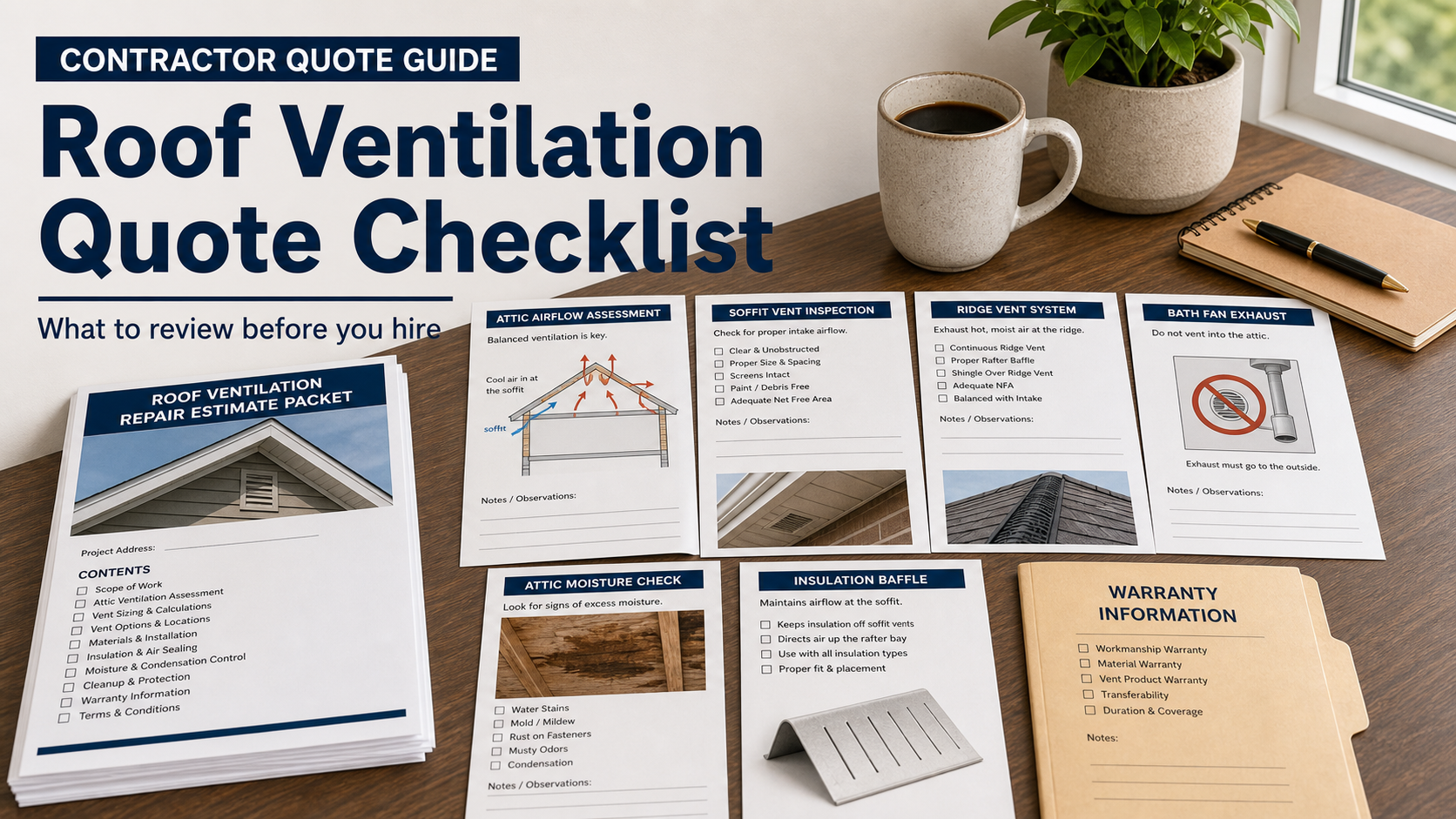
Roof ventilation problems often show up as hot rooms, ice dams, damp sheathing, musty attic smells, rusty nails, curled shingles, or mold-like staining. The fix is not always “add more vents.” A good quote starts by diagnosing why the attic is not drying or cooling properly.
Energy.gov describes ventilation as one part of controlling heat and moisture in a home. EPA’s mold guidance also makes moisture control central. That means a roof ventilation quote should not ignore bath fans dumping into the attic, missing air sealing, blocked soffits, or wet insulation.
Start With The Symptom And Cause
The estimate should say what problem is being solved: high attic temperature, condensation, mold-like growth, roof deck staining, ice dam history, premature shingle aging, or comfort complaints. It should also state what the contractor inspected before recommending repairs.
Ask for attic photos, roof photos, vent counts, soffit condition, insulation depth, and visible moisture indicators. If the diagnosis is only “needs ventilation,” the quote is not detailed enough.
Check Intake And Exhaust Balance
Ventilation works as a path. Air usually enters through lower intake vents such as soffits and exits through higher exhaust vents such as ridge, roof, or gable vents. The quote should identify both sides of the path.
Adding roof vents without clear intake can disappoint homeowners. Ask whether soffit vents are painted shut, blocked by insulation, missing baffles, or covered by debris.
Look For Moisture Sources
Bathroom fans, kitchen fans, dryer vents, humidifiers, air leaks from the living space, and roof leaks can all put moisture into an attic. The quote should state whether bath fan ducting terminates outdoors and whether air sealing is recommended before or alongside ventilation repair.
If the contractor proposes mold treatment or sheathing cleaning, ask whether the moisture source is fixed in the same scope.
Separate Roofing, Insulation, And Fan Work
The bid should separate vent installation, roof flashing, shingle repair, soffit work, baffles, insulation movement, bath fan ducting, and drywall or ceiling repair. If a roofer, insulation contractor, and electrician are all needed, the quote should say who coordinates each trade.
Warranty terms also matter. A vent installation warranty may not cover existing roof leaks, condensation from indoor humidity, or bath fans that still vent into the attic.
Roof Ventilation Quote Review Table
| Quote area | What to confirm | Why it matters |
|---|---|---|
| Diagnosis | Heat, condensation, stains, ice dams, comfort issue | The scope should solve the actual problem. |
| Intake | Soffits, baffles, insulation blockage, painted vents | Exhaust vents need air entering the attic. |
| Exhaust | Ridge, gable, roof vents, fan vents, flashing | Mixed vent types can perform poorly if not planned. |
| Moisture | Bath fans, roof leaks, air leaks, wet insulation | Ventilation alone may not stop moisture. |
| Closeout | Photos, airflow path, roof repair, warranty exclusions | Documentation helps if stains or leaks return. |
Questions To Ask Before Approval
- What symptom is the ventilation repair meant to solve?
- Were soffit vents, baffles, and insulation blockage inspected?
- What exhaust vents are being added, removed, or repaired?
- Are bath fans and dryer vents routed outdoors?
- Is air sealing included or recommended separately?
- Does the quote include shingle repair and flashing around new vents?
- Will insulation be moved, replaced, or protected?
- What photos or final inspection records will be provided?
- What does the warranty exclude?
Red Flags In A Roof Ventilation Estimate
- The quote adds roof vents without checking soffit intake.
- Bathroom fans that terminate in the attic are ignored.
- Moisture stains are treated without finding a moisture source.
- Roof flashing details are missing for new vents.
- Insulation and baffle work are assumed but not priced.
- The contractor promises ventilation will solve every attic issue.
Quote check: attic ventilation is a system. The quote should describe the airflow path and moisture source, not just the number of vents being installed.
Source Links
- Energy.gov: Ventilation
- Building America Solution Center: Condensation Control in Attics and Roofs
- EPA: A Brief Guide to Mold, Moisture and Your Home
- ENERGY STAR: Attic Air Sealing Project
- FTC: How to Avoid a Home Improvement Scam
FAQ
Will adding roof vents fix attic moisture?
Not always. Moisture may come from bath fans, roof leaks, indoor air leaks, humidifiers, or blocked soffits. The quote should identify the likely source.
Should soffit vents be checked?
Yes. Intake is essential. If soffits are blocked by insulation or paint, extra exhaust vents may not perform as expected.
Can bathroom fans vent into the attic?
They should exhaust outdoors. If bath fan ducts terminate in the attic, the quote should address that moisture source separately.
Does a roof ventilation quote include insulation work?
Only if the quote says so. Baffles, insulation movement, replacement, and air sealing are often separate line items.
What documentation should I ask for?
Ask for attic photos, roof photos, vent locations, notes on soffit intake, moisture findings, and warranty exclusions.