
Compare a home electrical load management quote by requiring an electrician's service and feeder load calculation, measured demand where allowed, a circuit-by-circuit inventory, explicit controlled and never-shed loads, exact listed equipment and installation method, sensor and contactor ratings, load-priority and recovery logic, behavior during communications or sensor failure, local manual override, EV, heat pump, water heater, range, dryer, battery and generator coordination, utility and permit approval, network and privacy boundaries, commissioning under real loads, owner training, and a support plan that does not make basic electrical service depend on an unavailable cloud account.
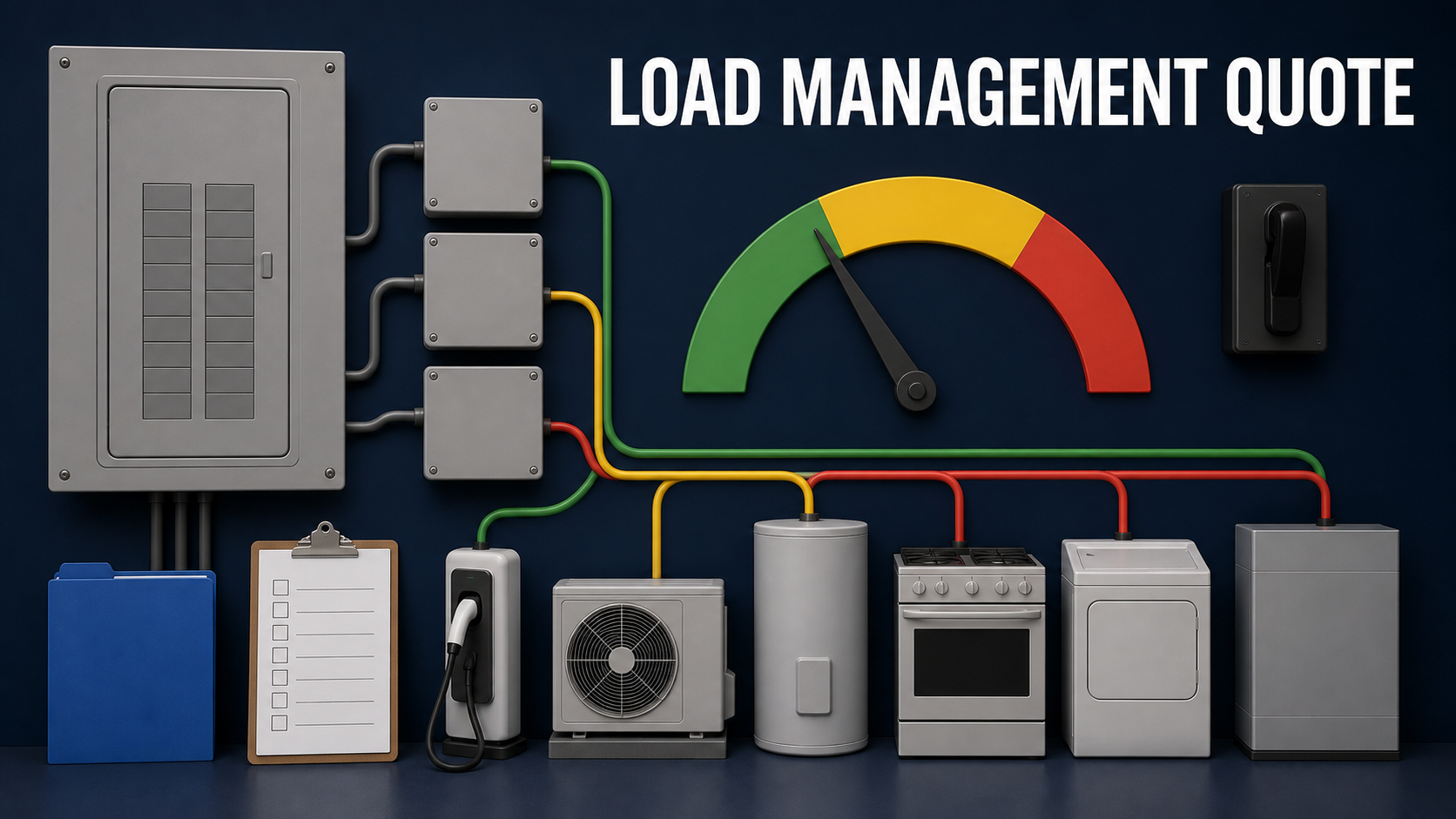
Load management can sequence, limit, or temporarily shed flexible electrical loads so new appliances operate within a service, feeder, or backup-power constraint. It may use a smart panel, dedicated controller, current sensors, relays, managed EV charging, appliance interfaces, or a combination, but it does not increase the physical rating of conductors, equipment, or utility service.
Do not compare proposals by the number of smart circuits or an app screenshot. DOE research treats load control as a capacity and resilience tool, while ENERGY STAR smart energy guidance emphasizes user control, consumption information, schedules, grid-response permissions, privacy and cybersecurity reporting, and override capability.
Prove Service, Feeder, And Panel Capacity
Define utility service rating, meter and service conductors, main device, panel bus, feeder ratings, existing calculated load, measured demand where accepted, voltage, phases, available spaces, fault rating, grounding, bonding, and known defects. The quote should name included materials, labor, access, preparation, interfaces, exclusions, assumptions, and the condition that changes the scope.
Require a signed load calculation, equipment inventory, panel photographs, utility data where used, and written conclusion about capacity and upgrade triggers. Load control cannot cure damaged equipment, undersized conductors, prohibited panels, or a calculation that omits major loads. Keep this evidence with the permit, change-order, inspection, and closeout records so acceptance does not depend on a verbal promise.
Define Controlled Loads And Priorities
Define EV charging, heat pump, resistance backup, water heating, range, dryer, pool, well, sump, refrigeration, medical and life-safety equipment, batteries, solar, generator, simultaneous use, comfort limits, and never-shed circuits. The quote should name included materials, labor, access, preparation, interfaces, exclusions, assumptions, and the condition that changes the scope.
Require a circuit and appliance schedule with ratings, starting loads, priority tiers, maximum interruption, recovery delay, and owner-approved rules. Undefined priorities can interrupt critical equipment or create repeated cycling, comfort loss, and appliance faults. Keep this evidence with the permit, change-order, inspection, and closeout records so acceptance does not depend on a verbal promise.
Specify Listed Hardware And Wiring
Define controller, panel, breakers, current transformers, relays, contactors, transfer equipment, enclosure, conductor and raceway, terminal ratings, temperature, serviceability, product listing, compatible loads, and manufacturer installation limits. The quote should name included materials, labor, access, preparation, interfaces, exclusions, assumptions, and the condition that changes the scope.
Require exact model and listing data, one-line diagram, wiring schedule, ratings comparison, and approved substitutions process. A low-voltage automation relay or mismatched sensor may not be suitable for controlling a high-current permanent load. Keep this evidence with the permit, change-order, inspection, and closeout records so acceptance does not depend on a verbal promise.
Lock Algorithms, Limits, And Fail-Safe States
Define service threshold, sensor sampling, load shed and restore sequence, minimum on and off times, hysteresis, startup surge, maximum outage, clock and tariff schedules, communications loss, sensor failure, controller reboot, power outage, and default contact state. The quote should name included materials, labor, access, preparation, interfaces, exclusions, assumptions, and the condition that changes the scope.
Require a written sequence of operations, fault-state table, local simulation results, and acceptance thresholds. Poor logic can oscillate loads, exceed service limits, or leave appliances permanently off after a minor fault. Keep this evidence with the permit, change-order, inspection, and closeout records so acceptance does not depend on a verbal promise.
Coordinate EV, Appliances, Solar, Battery, And Generator
Define managed EV charging protocol, appliance manufacturer interfaces, inverter and battery modes, generator capacity, transfer switching, island operation, export limits, backup priorities, demand response, and utility programs. The quote should name included materials, labor, access, preparation, interfaces, exclusions, assumptions, and the condition that changes the scope.
Require compatibility confirmations, operating diagrams for grid and outage modes, utility approvals, and a tested interaction matrix. Devices that work separately can conflict when control ownership, islanding, charging, or backup limits are not defined. Keep this evidence with the permit, change-order, inspection, and closeout records so acceptance does not depend on a verbal promise.
Preserve Local Control, Privacy, And Cybersecurity
Define local operation without internet, app and account ownership, Wi-Fi or wired network, remote access, permissions, utility or vendor control, data collected, retention, export, encryption, updates, account transfer, subscription, and end-of-service behavior. The quote should name included materials, labor, access, preparation, interfaces, exclusions, assumptions, and the condition that changes the scope.
Require a data and access schedule, local override demonstration, documented offline mode, owner credentials, update policy, and subscription disclosure. A cloud outage, expired subscription, sold property, or compromised account should not disable safe control of permanent electrical equipment. Keep this evidence with the permit, change-order, inspection, and closeout records so acceptance does not depend on a verbal promise.
Plan Permits, Installation, And Safe Bypass
Define licensed electrical work, utility notification, permits, shutdown, service seals, working clearances, panel replacement or retrofit, labeling, surge protection, firestopping, drywall repair, manual bypass, emergency operation, and inspection. The quote should name included materials, labor, access, preparation, interfaces, exclusions, assumptions, and the condition that changes the scope.
Require permit and utility responsibilities, installation drawings, bypass procedure, labels, concealed-work photographs, and inspection approval. Unapproved field modifications or an inaccessible bypass can create code, insurance, and emergency-service problems. Keep this evidence with the permit, change-order, inspection, and closeout records so acceptance does not depend on a verbal promise.
Commission Under Real Loads And Support It
Define sensor orientation and calibration, each controlled circuit, full-load threshold, shed timing, recovery, simultaneous starts, communications loss, controller reboot, manual override, outage and backup modes, alerts, logs, firmware, warranty, spare parts, and service response. The quote should name included materials, labor, access, preparation, interfaces, exclusions, assumptions, and the condition that changes the scope.
Require signed test script with measured currents and timestamps, fault demonstrations, baseline configuration export, owner training, support contacts, and labor and product warranties. An app showing circuit names is not proof that sensors, thresholds, contactors, and fail-safe behavior work at real load. Keep this evidence with the permit, change-order, inspection, and closeout records so acceptance does not depend on a verbal promise.
Review The Quote From Service Capacity To Fail-Safe Control
Prove Electrical Capacity And Load Priorities
Prove Service, Feeder, And Panel Capacity
Confirm utility service rating, meter and service conductors, main device, panel bus, feeder ratings, existing calculated load, measured demand where accepted, voltage, phases, available spaces, fault rating, grounding, bonding, and known defects; retain a signed load calculation, equipment inventory, panel photographs, utility data where used, and written conclusion about capacity and upgrade triggers.
Define Controlled Loads And Priorities
Confirm EV charging, heat pump, resistance backup, water heating, range, dryer, pool, well, sump, refrigeration, medical and life-safety equipment, batteries, solar, generator, simultaneous use, comfort limits, and never-shed circuits; retain a circuit and appliance schedule with ratings, starting loads, priority tiers, maximum interruption, recovery delay, and owner-approved rules.
Prove Safe Operation And Support
Plan Permits, Installation, And Safe Bypass
Confirm licensed electrical work, utility notification, permits, shutdown, service seals, working clearances, panel replacement or retrofit, labeling, surge protection, firestopping, drywall repair, manual bypass, emergency operation, and inspection; retain permit and utility responsibilities, installation drawings, bypass procedure, labels, concealed-work photographs, and inspection approval.
Commission Under Real Loads And Support It
Confirm sensor orientation and calibration, each controlled circuit, full-load threshold, shed timing, recovery, simultaneous starts, communications loss, controller reboot, manual override, outage and backup modes, alerts, logs, firmware, warranty, spare parts, and service response; retain signed test script with measured currents and timestamps, fault demonstrations, baseline configuration export, owner training, support contacts, and labor and product warranties.
Home Load Management Quote Comparison
| Quote area | What to confirm | Why it matters |
|---|---|---|
| Prove Service, Feeder, And Panel Capacity | utility service rating, meter and service conductors, main device, panel bus, feeder ratings, existing calculated load, measured demand where accepted, voltage, phases, available spaces, fault rating, grounding, bonding, and known defects. | Load control cannot cure damaged equipment, undersized conductors, prohibited panels, or a calculation that omits major loads. |
| Define Controlled Loads And Priorities | EV charging, heat pump, resistance backup, water heating, range, dryer, pool, well, sump, refrigeration, medical and life-safety equipment, batteries, solar, generator, simultaneous use, comfort limits, and never-shed circuits. | Undefined priorities can interrupt critical equipment or create repeated cycling, comfort loss, and appliance faults. |
| Specify Listed Hardware And Wiring | controller, panel, breakers, current transformers, relays, contactors, transfer equipment, enclosure, conductor and raceway, terminal ratings, temperature, serviceability, product listing, compatible loads, and manufacturer installation limits. | A low-voltage automation relay or mismatched sensor may not be suitable for controlling a high-current permanent load. |
| Lock Algorithms, Limits, And Fail-Safe States | service threshold, sensor sampling, load shed and restore sequence, minimum on and off times, hysteresis, startup surge, maximum outage, clock and tariff schedules, communications loss, sensor failure, controller reboot, power outage, and default contact state. | Poor logic can oscillate loads, exceed service limits, or leave appliances permanently off after a minor fault. |
| Coordinate EV, Appliances, Solar, Battery, And Generator | managed EV charging protocol, appliance manufacturer interfaces, inverter and battery modes, generator capacity, transfer switching, island operation, export limits, backup priorities, demand response, and utility programs. | Devices that work separately can conflict when control ownership, islanding, charging, or backup limits are not defined. |
| Preserve Local Control, Privacy, And Cybersecurity | local operation without internet, app and account ownership, Wi-Fi or wired network, remote access, permissions, utility or vendor control, data collected, retention, export, encryption, updates, account transfer, subscription, and end-of-service behavior. | A cloud outage, expired subscription, sold property, or compromised account should not disable safe control of permanent electrical equipment. |
Questions To Ask Before Approval
- How will the proposal define utility service rating, meter and service conductors, main device, panel bus, feeder ratings, existing calculated load, measured demand where accepted, voltage, phases, available spaces, fault rating, grounding, bonding, and known defects and prove it with a signed load calculation, equipment inventory, panel photographs, utility data where used, and written conclusion about capacity and upgrade triggers?
- How will the proposal define EV charging, heat pump, resistance backup, water heating, range, dryer, pool, well, sump, refrigeration, medical and life-safety equipment, batteries, solar, generator, simultaneous use, comfort limits, and never-shed circuits and prove it with a circuit and appliance schedule with ratings, starting loads, priority tiers, maximum interruption, recovery delay, and owner-approved rules?
- How will the proposal define controller, panel, breakers, current transformers, relays, contactors, transfer equipment, enclosure, conductor and raceway, terminal ratings, temperature, serviceability, product listing, compatible loads, and manufacturer installation limits and prove it with exact model and listing data, one-line diagram, wiring schedule, ratings comparison, and approved substitutions process?
- How will the proposal define service threshold, sensor sampling, load shed and restore sequence, minimum on and off times, hysteresis, startup surge, maximum outage, clock and tariff schedules, communications loss, sensor failure, controller reboot, power outage, and default contact state and prove it with a written sequence of operations, fault-state table, local simulation results, and acceptance thresholds?
- How will the proposal define managed EV charging protocol, appliance manufacturer interfaces, inverter and battery modes, generator capacity, transfer switching, island operation, export limits, backup priorities, demand response, and utility programs and prove it with compatibility confirmations, operating diagrams for grid and outage modes, utility approvals, and a tested interaction matrix?
- How will the proposal define local operation without internet, app and account ownership, Wi-Fi or wired network, remote access, permissions, utility or vendor control, data collected, retention, export, encryption, updates, account transfer, subscription, and end-of-service behavior and prove it with a data and access schedule, local override demonstration, documented offline mode, owner credentials, update policy, and subscription disclosure?
- How will the proposal define licensed electrical work, utility notification, permits, shutdown, service seals, working clearances, panel replacement or retrofit, labeling, surge protection, firestopping, drywall repair, manual bypass, emergency operation, and inspection and prove it with permit and utility responsibilities, installation drawings, bypass procedure, labels, concealed-work photographs, and inspection approval?
- How will the proposal define sensor orientation and calibration, each controlled circuit, full-load threshold, shed timing, recovery, simultaneous starts, communications loss, controller reboot, manual override, outage and backup modes, alerts, logs, firmware, warranty, spare parts, and service response and prove it with signed test script with measured currents and timestamps, fault demonstrations, baseline configuration export, owner training, support contacts, and labor and product warranties?
Red Flags In This Quote
A proposal that promises to avoid a service upgrade without a documented load calculation, equipment ratings, utility conditions, and authority approval is incomplete.
A circuit list without never-shed loads, maximum interruption, recovery timing, and fault defaults can create unsafe or unusable behavior.
Permanent electrical control that stops functioning without a vendor cloud, subscription, or transferable account needs an explicit safe offline mode.
Primary References & Homeowner Resources
- DOE smart electrical panel-based home energy management project
- DOE residential panel constraints and electrification solutions
- ENERGY STAR smart home energy management key criteria
- DOE building load control strategies
FAQ
Does load management increase electrical service capacity?
No. It controls when selected loads operate so demand stays within a defined limit. Conductors, panels, feeders, utility equipment, and fault ratings remain unchanged.
Can it help avoid a panel or service upgrade?
Sometimes, when a code- and utility-accepted calculation and listed control method show the new loads can be safely managed. Existing defects or capacity constraints may still require upgrades.
Which loads should never be shed?
That is site-specific. Life safety, medical needs, refrigeration, sump or well functions, heating protection, alarms, and other critical loads require explicit classification and fallback planning.
What happens if the internet fails?
Basic protection and local logic should follow the documented offline mode. Confirm local sensing, safe defaults, manual override, alerts, and whether remote features alone are unavailable.
Can a system coordinate an EV charger and heat pump?
Yes when the selected equipment and interfaces are compatible and the sequence accounts for starting loads, comfort, charge needs, priority, and recovery.
What should commissioning prove?
Verify sensor mapping and calibration, threshold response, each contactor, priority order, restore timing, fault defaults, communications loss, override, and applicable backup or utility modes under measured load.
Related Home Repair & Remodel Guides
- EV charger installation quote checklist
- Electrical panel replacement quote checklist
- Home battery installation quote checklist
A home load-management quote is ready when service capacity, load priorities, listed hardware, control and fault logic, local overrides, device coordination, permits, real-load tests, privacy, and support all agree.