
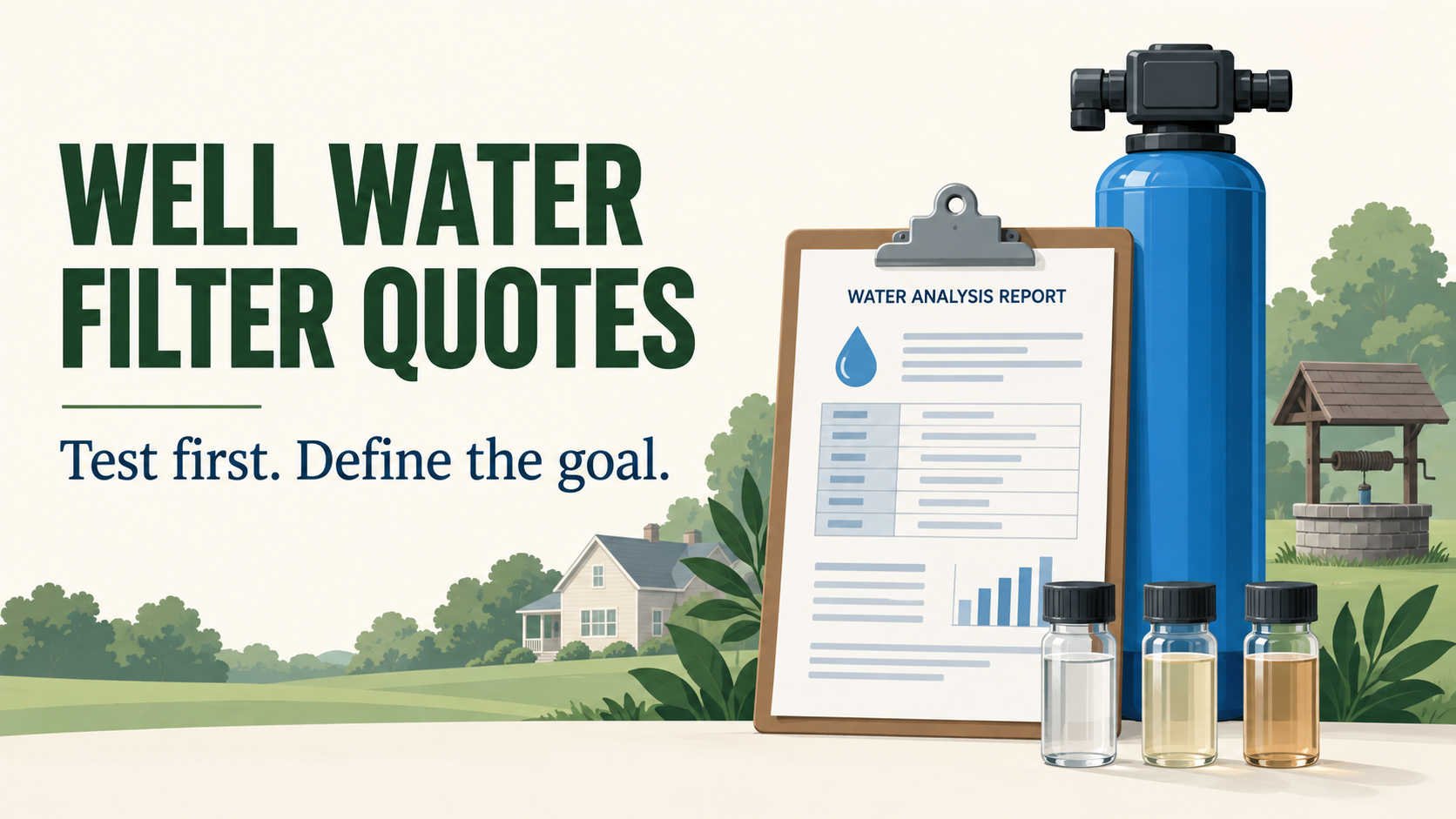
Compare a private well treatment quote against a water test report and a specific treatment goal. Before choosing equipment, identify what needs to be reduced, where treated water is needed, and how the installer will verify the result. A large cabinet, a long warranty, or the phrase “whole-house purification” cannot answer those questions.
This is a purchasing and installation-scope guide, not a diagnosis of water safety. If a report identifies a health concern, follow the instructions of the laboratory and local health authority about water use while the issue is addressed. Do not assume that installing any filter makes an unknown water supply suitable for drinking.
Put the test report at the front of the bid packet
EPA’s private-well guidance describes owner responsibilities, testing, and local assistance. Use that starting point to arrange appropriate testing rather than relying only on appearance, taste, or a sales demonstration. Ask the laboratory or health department which tests fit the well and local conditions, and keep the sample date and sample location with the results.
Give each bidder the same report. If one installer is quoting treatment for a measured contaminant and another is quoting a taste-and-odor improvement, their proposals are solving different problems. Write a short goal statement in ordinary language and have the installer connect each equipment stage to that goal.
Separate the water source from the treatment equipment
A treatment proposal should identify whether the installer has considered the well itself, the pressure equipment, and the existing plumbing. Some findings may require well inspection or repairs outside a filter installation. Ask who will investigate those findings and whether the equipment order should wait for the results.
Keep unresolved findings visible
Make an “open questions” box on the first page: additional testing, available flow information, discharge destination, electrical work, and responsibility for follow-up sampling. A written unknown is easier to resolve than an assumption hidden in a fixed total. Require an answer or a clearly described allowance before treating two totals as comparable.
Compare point-of-use and whole-home proposals by purpose
CDC distinguishes filters installed at an individual use point from systems treating water as it enters the home. The appropriate arrangement depends on the identified problem and intended uses. Ask the bidder why the quoted treatment boundary fits the test results; do not select the larger system simply because it treats more fixtures.
| Decision | What the quote should explain | Useful evidence |
|---|---|---|
| Treatment goal | Which measured issue each stage addresses | Test report and written design basis |
| Treatment location | Which taps or uses receive treated water | Simple plumbing diagram |
| Product claim | Exact model and contaminant-reduction claim | Certification listing and performance sheet |
| Installation services | Plumbing, power, drainage, and access | Itemized scope and exclusions |
| Verification | Sampling location, timing, and responsibility | Written commissioning plan |
For a hypothetical comparison, imagine one bid for a kitchen drinking-water system and another for an entry-point system serving the whole home. The second price cannot be judged as an expensive version of the first until the intended uses are aligned. Ask both bidders to explain what remains untreated and why their proposed boundary is appropriate. This example does not imply either arrangement is correct for a particular contaminant.
Read the actual product claim
NSF’s consumer guidance connects product certification with specific contaminant-reduction claims. Request the exact model’s listing, not just a photograph of a certification mark. A product certified for one claim should not be treated as proven for every concern on the laboratory report.
Keep the performance sheet with the quote and ask about its operating limits. The installer should explain how the proposed equipment fits the home’s water conditions and demand. If the answer depends on a pretreatment stage, that stage, its maintenance, and its replacement supplies belong in the comparison as well.
Do not turn a general statement about a treatment technology into a guarantee for a particular product. The practical buying question is whether the named equipment, in the proposed arrangement and operating conditions, supports the written goal and can be checked after installation.
Account for the service work around the filter
Ask what plumbing changes are included, where equipment will fit, and how technicians will reach serviceable parts. Depending on the proposed system, power, drain connections, reject water, or regeneration discharge may also need planning. Have the installer identify applicable local requirements and coordinate with any other trades.
Where a home uses a septic system, bring proposed discharge details to the appropriate local professional before approving the connection. Our septic repair quote guide explains how to keep system-related work and exclusions visible. For valve access and plumbing isolation, see the main water shutoff valve scope guide.
Price ownership, then define acceptance
- List cartridges, media, lamps, salt, or other consumables actually required by the proposed system.
- Ask for current replacement-part and service quotes without assuming those prices remain fixed.
- Identify who records service dates and how an overdue task becomes visible.
- Specify the follow-up testing plan and who interprets the result.
- Keep manuals, model numbers, baseline settings, and service contacts together.
Ask the contractor to separate equipment warranty coverage from performance verification. A warranty may address a failed component without answering whether the treatment goal was achieved. Likewise, clear-looking water is not a substitute for the agreed test. The closeout meeting should reconcile the installed equipment, the maintenance instructions, and the documented verification result.
Frequently asked questions
Can taste tell me which filter to buy?
No. Start with appropriate testing and a defined goal. Appearance and taste cannot establish the absence of contaminants.
Does a certification logo cover every contaminant?
No. Check the exact model and its listed reduction claims, along with relevant operating conditions.
Is whole-home treatment always better?
Not automatically. Ask why the treatment location and uses fit the identified problem.
Should a quote include follow-up sampling?
Ask for a written verification plan that names the responsible party, sample location, and next step if the result misses the goal.
What makes two bids comparable?
The same test information, treatment objective, service boundary, and maintenance assumptions. Equal equipment counts are not enough.
Primary references
- EPA: protect your home’s private well water
- CDC: choosing home water filters
- NSF: contaminant reduction claims guide
Sources checked September 14, 2026. Obtain site-specific testing and treatment advice from qualified local professionals.