Short answer: Approve a sewer backwater valve installation quote only after the plumber confirms the backup source and ownership boundary, maps the building drain, lateral, fixtures and elevations, identifies which fixtures are protected or require separate routing, selects a code-approved accessible valve, documents pipe condition and flow direction, defines excavation or slab work and utility protection, includes permits, inspection and functional testing, restores finishes and grade, and provides cleaning, storm-use, warning, maintenance, warranty, and as-built records.
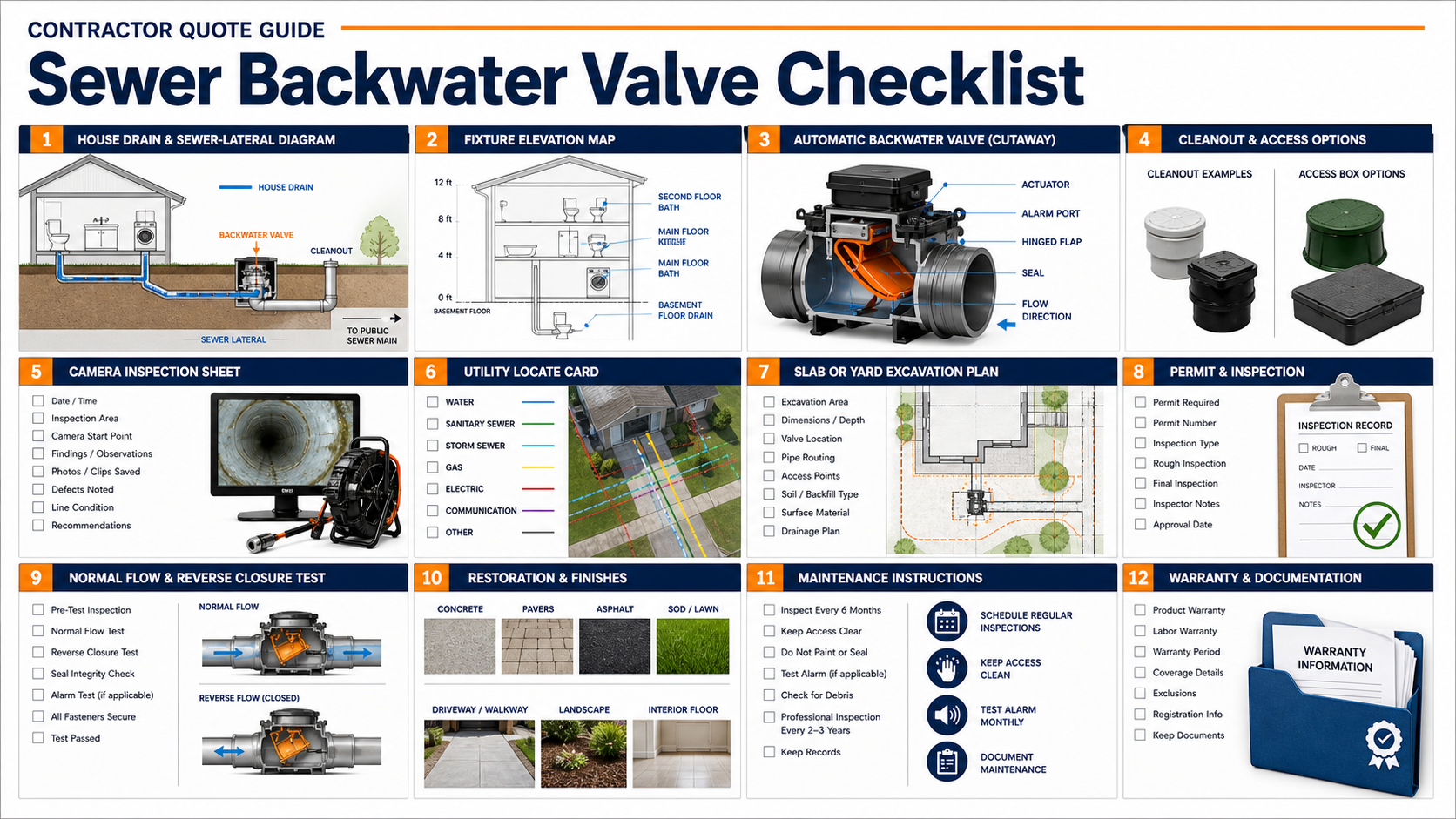
A backwater valve closes against reverse sewer flow, but it also blocks wastewater trying to leave the home while closed. Its location, fixture elevations, branch connections, roof and foundation drains, pipe condition, cleanout access, and household behavior during storms determine whether it reduces or relocates the backup risk.
Compare bids only after every plumber uses the same drain map and protected-fixture boundary. One quote may include camera inspection, branch separation, permits, exterior excavation, accessible vault, concrete and floor repair, tests and maintenance training while another lists only a valve in an assumed location.
Confirm The Backup Path And Responsibility Boundary
Document where wastewater or stormwater appeared, weather and municipal surcharge conditions, blockages, roots, defects, pump failures, combined or separate sewer, previous cleaning, insurance reports, and whether the public main or private lateral was involved. A backwater valve does not repair a collapsed or obstructed private pipe.
Identify the owner, utility and municipal responsibility limits, required approvals, and any local subsidy conditions. Use camera inspection or other appropriate evidence to confirm pipe material, diameter, slope, joints, defects, flow direction, branches, cleanouts, and a workable valve location.
Map Every Fixture And Drain Connection
Draw lowest fixture elevations and connections for toilets, tubs, showers, sinks, floor drains, laundry, sump, foundation drainage, roof leaders, yard drains, ejector pumps, upper-floor stacks, and additions. Mark what lies upstream and downstream of the proposed valve.
The quote should explain which fixtures remain usable when the valve closes and whether any branches need rerouting, pumping, separate protection, or disconnection. Connecting prohibited storm or groundwater sources to the sanitary line should not be hidden by a new valve.
Select An Approved Valve And Accessible Location
Specify valve type, size, material, listing or local approval, full-port flow path, automatic flap or gate arrangement, manual features, alarms if included, orientation, fittings, cleanouts, bedding, and compatibility with the existing pipe. State why the device fits the building's risk and maintenance capacity.
Place the access cover where the flap or mechanism can be inspected, removed and cleaned without demolition. Include an interior access box or exterior vault, cover rating, drainage, freeze and groundwater protection, odor seal, child safety, and clearance for service tools.
Define Excavation, Utilities, And Pipe Replacement
Locate public and private utilities, gas, water, electric, communications, irrigation, radon, foundation drains, footings, and other buried services. Map slab cutting, dust and silica controls, shoring or trench protection, spoil handling, groundwater, pipe support, bedding, connections, temporary plumbing outage, and occupied access.
State the length and material of pipe replaced around the valve, how poor pipe or roots are handled, and unit prices or approval gates for discoveries. Include concrete, waterproofing, vapor barrier, flooring, walls, yard, paving, landscaping, and final grading boundaries.
Permit, Inspect, And Test Both Flow Directions
Name permit applicant, fees, utility coordination, rough inspection, concealed-work hold point, final inspection, and local documentation. Do not cover the valve, pipe joints, bedding, or access assembly until required review is complete.
Test normal downstream drainage from relevant fixtures, observe for leakage and obstruction, verify automatic closure against simulated reverse flow when safely permitted, confirm reopening, inspect cleanouts and access, and demonstrate any alarm or manual control. Record the test rather than relying only on visual installation.
Train The Household And Preserve Maintenance Access
FEMA warns that when a backwater valve closes, water used inside cannot drain past it and can back up in the home. Provide clear instructions to stop using toilets, sinks, showers, laundry and dishwashing during surcharge risk or confirmed closure, plus a practical alert and household communication plan.
Collect permit and inspection approval, camera findings, as-built drain map, valve data, photographs before cover, test record, cleanout and access instructions, inspection and cleaning interval, debris removal method, storm-use checklist, emergency contact, restoration signoff, and warranty.
Sewer Backwater Valve Scope Comparison
| Quote area | What to confirm | Why it matters |
|---|---|---|
| Backup diagnosis | Event history, obstruction and pipe defects, public/private boundary, camera findings, diameter, material, slope, flow, branches, and cleanouts | Confirms a valve addresses the actual reverse-flow path |
| Protected fixtures | Lowest fixtures, stacks, floor drains, laundry, sump, foundation and roof drainage, branches, pumps, and upstream/downstream map | Shows what remains protected and usable when the valve closes |
| Valve and access | Approved type, size, material, flow path, manual or alarm features, cleanouts, vault or box, cover, drainage, freeze protection, and service clearance | Makes inspection and cleaning possible after installation |
| Construction | Utilities, slab or trench, dust, shoring, groundwater, pipe replacement, support, bedding, outage, concrete, vapor barrier, floor, yard, and grade | Captures the disruptive work surrounding the device |
| Approval and tests | Permit, utility, rough and final inspections, hold point, normal flow, reverse closure, reopening, leaks, access, and alarm | Verifies both daily drainage and backup protection |
| Handoff | As-built map, camera and photos, approvals, test record, storm-use rules, cleaning interval, emergency contact, restoration, and warranty | Keeps the valve operable and the household informed |
Questions To Ask Before Approval
- What evidence shows reverse sewer flow caused the backup rather than a private blockage or failed pump?
- Can I see the drain, lateral, branch, cleanout, lowest-fixture, roof, foundation, sump, and proposed-valve map?
- Which fixtures are protected and what happens to household wastewater while the valve is closed?
- Why is this valve type, size, location, access box or vault, and maintenance clearance appropriate?
- Which utilities, slab, trench, pipe, waterproofing, flooring, yard, and grading work are included?
- How will normal flow, reverse closure, reopening, leaks, alarms, permits, and inspections be verified?
- What storm-use instructions, cleaning schedule, as-built records, emergency contact, restoration, and warranty will I receive?
Red Flags In This Quote
Installing a valve without diagnosing a collapsed, rooted, or obstructed private lateral may leave the original backup cause unchanged.
A buried valve with no serviceable access cannot be reliably inspected or cleaned when debris threatens the closing mechanism.
Telling occupants they can use plumbing normally during a sewer surcharge ignores the risk of their own wastewater backing up behind a closed valve.
Source Links
- FEMA Urban Flooding guidance for homeowners and renters
- FEMA Mitigation Assessment Team urban flooding report
- FEMA floodproofing plumbing provisions reference
FAQ
Does a backwater valve stop every basement flood?
No. It addresses reverse flow through connected drains. Surface water, foundation seepage, plumbing leaks, blocked private pipes, sump failures, and unprotected branches need separate diagnosis.
Can I use water while the valve is closed?
Avoid it. FEMA explains that wastewater cannot pass a closed valve and may back up inside. The installer should provide a storm and closure-use plan.
Where should the valve be installed?
The location depends on the drain layout, lowest fixtures, branch connections, pipe condition, code, access, and which portions need protection. It must remain inspectable and cleanable.
Does the valve need maintenance?
Yes. Debris can interfere with closure. Keep the access clear and follow documented inspection, cleaning, test, and replacement-part instructions.
What should the final test include?
Verify unobstructed normal flow, watertight joints, safe reverse-flow closure test when permitted, reopening, cleanouts, access cover, alarms or manual features, and relevant fixtures.
Related Contractor Quote Guide Guides
- Sewer line replacement quote checklist
- Sump pump replacement quote checklist
- Basement waterproofing quote checklist
A backwater-valve quote is complete when the reverse-flow path, protected fixtures, serviceable device, construction limits, two-direction test, household use rules, and maintenance record all match.